• The Girl in My Garage

    Monday

    I love it when it gets so smoky in here that everything is dusted with fragrant incense ash. I’ve been praying for so long that my knees hurt and I can’t feel my ankles. The white candles burn through the haze, but I can’t see who I’m chanting at. The term for my new uni course starts tomorrow, and essentially I’m praying for it to go well. For me to develop connections;; for me to learn.

    I’ll most probably be greeted by some kind of mostly improbable threat veiled as a question if I leave the garage. There doesn’t need to be a reason! So I’m still in here. I can hardly countenance living here for another month, but I suppose however many years it takes to do this and get out will have to do.

    Wednesday

    I was busy catching up on the introductory material for my new subjects, I didn’t have time to write yesterday. Of the course material so far,,, of course it is engaging to me. Of course I am looking forward to the course. I’ve been studying law to get into this position for well over a year, and I’m finally here. I’m sure it will be okay, and in fact I’m confident about the future!

    Friday

    I don’t know, maybe this should be an every two days thing. That would probably be more convenient. I was working yesterday evening and all of today as well! I hate it! Everyone there is either much older than me or 17. I have literally nobody to interact with in a way that’s not confrontational or forced – not that I’d want to be interacting much considering how many clients we have to deal with the entire time. Then I come home and dad has his daily pet peeve thing he made up to yell about. Fuck this.

    Monday

    Okay look, it will be every two days. If I don’t get into the habit of writing in this regularly it won’t happen at all; this ain’t my first rodeo. Buddy. In my defence, I’m exhausted and unfocused from a week of work by the time I get home on Sunday. Speaking of focus, I know damn well I need ritalin to do this course and I have saved up a massive store of it so I don’t have to pay a million billion dollars for psychiatrist appointments to get access to more. I have about 500 small tablets, so if I only take four per week I can stretch it out well into next year. It would make me stressed to take much more than that anyway.

    Wednesday

    Got several classes going this semester. I am mainly interested in common law, civil law and legislation related to that, but of course we’ll be looking into criminal law, the ICJ and some generic introductory stuff. Funnily enough, the international law subject seems the most interesting so far – the lecturer is an entertaining Brazilian lady. I don’t have much to go off for what my mother was like, but I understand that she was forward and vivacious in a similar way. You wouldn’t expect any less from a hard-working Mexican woman, really. I don’t know how she ever ended up with dad.

    We will have to do a set of quizzes in a couple of weeks for an introductory subject, and then the first essay will be for international law – about the United Nations, I think. I have lots of time to prepare, I’ve checked out when the major events are happening in each subject and generally I feel positive about it.

    Friday

    Ok, I’m writing during my break at work. Generally I don’t need ritalin here because I’ve gotten used to doing all the stuff I would’ve needed to do with it. I guess I never need it – I certainly don’t like using it – but I regretted not having it at school because I could never bring myself to study. I’ll mostly need it for study days, which will be Monday, Wednesday, Saturday and it’s hard to decide another one. Tuesday I have a class in the morning and another in the evening, Thursday I have a class in the morning and work in the evening, today and Sunday are work all day. Idk. Eventually, I will also have to find a cheaper psychiatrist if such a thing exists. It’s probably been more than a year since I talked to the one who prescribes me ritalin, so I haven’t been able to buy up more for a long while. The doctor who referred me to this one (and also gave me a bunch of other options I didn’t keep track of) is dead

    Sunday

    I don’t get a Sunday, I have to work a six hour shift lool. Too tired to really get stuff done in the afternoon. I think I’ve been working there for too long, I don’t care about it and nobody cares if I’m there. I know how to fill out the paperwork and I can do the customer service stuff in my sleep. They need me there more than I need them. I would probably welcome getting fired, but it won’t happen. Today I drew a picture of myself getting fired out of a cannon and into the sun. My life generally feels like a dead end, but I’m excited about uni at least.

    Tuesday

    Tuesdays never feel good. I don’t know why it’s always so busy here, but it makes everyone more tense. Customers are ruder. There’s probably no day I would want to work less, but my uni subjects are happening on other days. I still need as much work as I can get, really. It’s wild because if I’m going to uni Monday, Tuesday, Wednesday, Thursday and working Tuesday, Thursday, Friday, Sunday it’s almost as busy as it was when I was working full time.

    Thursday

    Last week I met an extroverted Chinese girl in the international law class. Her name is Shirley. We went out after class with two other girls, and I showed them where to find lunch in St Albans. We came back to the campus to study after that. Anyway, this week it was just us. She asked for my Instagram account and we went to lunch again. We did some study on campus. Haven’t said anything since yesterday, but I don’t really use Insta. I’m not sure where it will go from here, nothing like this has happened before.

    Saturday

    Shirley seems really invested in learning about the functions of the UN and the history of the ICJ. It’s kind of impressive – is this what studying with other people is generally like? When I say ‘study’ like we’ve just been shooting messages over Insta I suppose. It tends to be pretty hard to focus on actual study in this fucking household. When dad’s not crashing around drunk the neighbours across the street are having a party or the couple upstairs are arguing about some stupid shit.

    Monday

    The Monday subject is so boring that it actually feels like a waste of time me being there. I don’t think I will need to study very much for it;; third week now and not one thing the lecturer has said was new information to me. ‘Ooh do you know what a tort is?’ shut up bro. I guess I should be pleased that I understand the material – I might not do with the second year subjects. For now though it seems like much of my time is taken up just travelling to and from places and listening to people talk shite.

    Wednesday

    You might wonder how, if I am 22, I’ve never so much as kissed a girl. I wonder this sometimes. But I think I have a date with Shirley next week? It’s kind of hard to tell. She’s only been in Australia since November; her English is surprisingly strong, but she did spend most of her life in Anhui. I’m calling it a date. Anyway idk the teacher (Isabella) is kind of grating on me because I’m not very sociable and she clearly doesn’t get why. Maybe I don’t get why.

    Friday

    My god I need a new job. Honestly it feels cowardly the way I’m still there. Nobody teaches you how to quit a job and then still put it on your resume for the next one, anyway. Like surely in an interview they will be like ‘uh yeah sure you were here for four years, can we have a contact to ask them about your performance?’ How do you respond ‘NAH I told them to lick balls and they didn’t like me anyway’ and still get the job idgi tbh.

    Sunday

    Getting excited like I’m some kind of puppy. Date is tomorrow. Assessment is due on Wednesday. Fuck the assessment. I don’t really want a girlfriend but it’s still early days, right? I want to be in a relationship, it doesn’t need to be boyfriend-girlfriend I don’t think. I wouldn’t tell my dad about her either way. I could take her into my room and he probably wouldn’t even notice.

    Tuesday

    It went well, I think. We got lunch in Footscray. I let her choose and so we got Chinese of course. She was talking about using online chat sites and seeing foreigners behaving badly. Not sure what to make of it. We held hands walking down the street. We looked through the mall. Then I went to uni for the evening. Tomorrow I will need to get stuck into the UN essay. I haven’t written much.

    Thursday

    Okay, I just got the essay in. Okay, it’s a day late. Okay, I lose five percent of the mark. I am okay with this outcome. It is okay. You know what else is okay? Shirley said she doesn’t want to be a girlfriend – which is the outcome I wanted! I don’t want a girlfriend! But I can’t exactly tell her that. It was probably a mistake to force the issue, but we are meeting again on Saturday.

    Saturday

    I don’t know what happened. We had dinner, then we walked all the way down the river towards my place. I don’t think she wanted to talk that much, but we were talking the whole time. At one point I jumped up onto a short metal pole, and then down again. She jumped up onto the next one along, but lost balance and fell the wrong way. I wasn’t close enough. She stopped moving after she hit the ground, and there must’ve been a couple of minutes where I just stood there as deep, thick liquid trickled out along the greying asphalt.

    I had to carry her back to our place. I had a shower, but I still don’t smell right. I have to go back downstairs, but not for as long as I can avoid it.

    Monday

    Called in sick to work yesterday. It felt like the right thing to do. I threw up before I went to sleep, so I guess it wasn’t lying to say I was sick. I spent all day in the garage praying, mostly to Santa Muerte. Shirley joined me – I think it calmed us both down. But today I decided to go into uni. I have another assessment due on Thursday.

    Wednesday

    International law classes are on Wednesday. Shirley wasn’t there;; of course not, she was staying here in the garage! I saw her in a different position when I got back; she was probably lighting incense without me. Her parents are probably worried, I guess. It makes sense that she would want to keep in touch with them. I’m glad dad never actually looks in here anymore.

    Friday

    The fucking ford falcon in this garage takes up so much of my time. Dad stopped actually working on it a couple of years ago, but I still need to clean it fairly often so that it isn’t caked in dust and ash. I’m not sure how I will do it with Shirley in here. I don’t want to change her clothes, I can’t shop for girls. I’ve lit more candles to disguise the smell, but it’s getting harder so I’m using as much incense as I can too.

    Sunday

    Still haven’t uploaded that second assignment, and I don’t even want to really. I had to work all morning and I had to pray all evening. I’m not dealing with assignments. I think I can still pass all the subjects if I lock in a month from now. And I will pass all the subjects. For both of us.

  • Australia as a Concept is Entirely Unsalvageable

    Originally published in late 2023

    I cannot emphasise enough the extent to which this country is the same settler-colonial outpost of the British Empire that it was 100 years ago. I don’t know how anyone deludes themselves about it, really. Just on the most surface level possible, this is a country which speaks nothing but English, pays allegiance to the King of England and maintains a Union Jack on the corner of its national flag. However, this is an issue which goes much deeper than vulgar republicanism.

    Indeed, Australian libs have long attacked the ‘cultural cringe’ of Australia’s parochial monarchist mainstream. Of course, it should irk them: how can one on any level maintain the notion that Australia is a ‘liberal democracy’ dedicated to ‘multiculturalism’ and ‘a fair go’ when its very institutions were established on the stolen land of a genocided Indigenous population with an explicit and continuing deference to the very motherland which carried out that genocide? Nearly a third of incarcerated people here are Indigenous and over half of the kids in gaol are Aboriginal. This is the most incarcerated population in the world, and it didn’t happen by accident.

    Naturally, republicanism is considered the ultimate solution to this unhappy present. Indeed, we must drag Australia into the bright and beautiful future of 1776. But it will be a drag. A slog. Hard yakka. It never seems very easy to move forward in this country. To move this country forward. It’s almost like it doesn’t want to move. Or perhaps, that nobody will commit to moving it…

    No. How brash of me to suggest. Don’t I remember that one prime minister in the 70s? Don’t I remember when he flew into the desert and poured some dirt into a black guy’s hands? Silly me. What a guy.

    Pollies basically gave up on the republic idea after they did a referendum on it in 1999. It didn’t pass, in case you’re unaware. The majority of prominent Australian pollies this century – including the entire current government – have been nominal republicans, but on some level everyone knows that it’s just symbolic nonsense, so there hasn’t been much of a push. Oh, the tension between embracing your role in a racial hierarchy and the pretense that the hierarchy doesn’t exist. I call it Whitefella’s Paradox.

    Still, 20th Century boomer idealism has been driving the corpse of the Australian Labor Party for several decades now. Last year, the ‘Vote for Albo’ movement apparently culminated in their return to power (note that they actually got the same vote share as the previous election, and much like in 2007, the Coalition vote share simply collapsed due to Rupert Murdoch taking his hands off the wheel), so that’s something. I wonder which investment property he celebrated in.

    Apart from incredible policy masterstrokes such as continuing tax cuts for millionaires in a recession, continuing to pretend trans people don’t exist and continuing to send refugees and asylum seekers to detention centres, Anthony Albanese’s government has mainly sought to define itself by the upcoming ‘Voice Referendum’. As with most of Labor’s policies, the Voice to Parliament was originally proposed by the Coalition. Not only was the passage of legislation establishing an Indigenous voice to the government agreed to by the Morrison Government, but that government itself suggested holding a referendum on whether to recognise Indigenous people in the constitution. The Albanese Government has simply reformulated the proposition so that the referendum is about enshrining a ‘Voice to Parliament’ in the constitution.

    There have been numerous Indigenous advisory bodies to the Australian government in the past, so the constitutional change is really the only significant thing here. Despite Albanese’s popularity, however, the referendum he’s defining his legacy on looks set to flop. What a fuckwit.

    Australian liberals, which in my experience are either over the age of 50, terminally online or almost completely disengaged from politics, have been seemingly dumbfounded by this state of affairs. In spite of their smug middle-class insistence that Australia is actually much more cool and open and progressive than the United States, it seems that time and time again Australians are happy to prove them wrong. And I mean honestly, who wouldn’t be happy to prove them wrong. Rightists have been saying the exact same things they always say; ‘waste of money, woke activism, racism against whites’, blah blah blah, you know the playbook. They know it works, I guess. I could do some kind of in-depth analysis on the ‘intersectional neo-reaction’ of promoting Aboriginal people that espouse neo-colonial views, but I really don’t think it’s necessary.

    Aussie leftists have been typically invisible from the discourse. I think they tend to know that, as almost anyone could’ve predicted, the actual referendum question has become ‘do you like racism?’, and are voting on that basis. I don’t know why I’m even bringing leftists up, they don’t actually exist outside of inner city cafes and a couple of Trotskyist orgs for uni students and old people. You see, to the relief of everyone that isn’t from Melbourne, Australia avoided the false hope of Corbynism and the DSA. Almost nobody thinks they’re gonna fall into parliament and do a socialism.

    With that being said, most millennial lefties support the Greens, and are just as tribal about it as their parents are about Labor. And then, why wouldn’t they be, when the Greens fill that irresistible reformist urge for ‘Keynesianism with an environmentalist twist’ so convincingly. Yeah, I’m doing something. I’m doing an activism. Voting. Voting for Good Party.

    Good Party had a senator called Lidia Thorpe for a couple of years, but then she had an opinion and they had to sound the Independent Thought Alarm. I’ve naturally been sceptical, but at this point I am convinced that she’s probably the only based person that has ever served in the Australian parliament. She consistently promotes the interests of marginalised communities, at her own expense, and she’s pledged to represent Blak Sovereignty. As I understand, her position on the referendum is essentially that, without the treaty and truth-telling which the Voice was proposed with, it seeks to further legitimise the settler-colonial domination of Indigenous Australians.

    I would ask why the government has forgotten about the ‘treaty and truth’ part of voice, treaty and truth, but it’s not even worth a rhetorical question. We know why. The Australian state cannot sign a treaty with Indigenous people, because it cannot acknowledge that Australian land is stolen. The Australian state likewise cannot acknowledge the truth, that it’s a settler-colonial enterprise established through the exploitation of Indigenous peoples and their resources, because those peoples are now apparently its citizens. I speak as though these are technicalities, but of course in reality states can work around this sort of thing. Australians certainly don’t want to, though. Even ‘progressives’ don’t like to be reminded that they’re on Aboriginal land when they’re not virtue signalling about it.

    Many people here don’t realise, but across the entirety of New South Wales, Victoria and Tasmania, Aboriginal people were battled, rounded up and locked into missions and reservations. This also occurred in the other states, but not to all of their Indigenous peoples. Then the kids were stolen. Now, this occurred right around the country, and continues to occur to this day in remote communities thanks to the NT Intervention.

    Now, we know that in the 2007 Intervention, the federal government suspended the Racial Discrimination Act, and all Aboriginal claims not only to their own land, but to their own autonomy. But the Intervention didn’t end in 2007. So many of its explicitly white supremacist measures are still in place. Welfare quarantining is more commonplace than ever across the disadvantaged communities of this country. Community policing and youth incarceration are more prevalent than ever. There’s much to be said about how the Mabo court case acknowledged Australia’s status as an ‘inhabited settled colony’ directly subject to the crown1, but the idea that it fundamentally changed how Indigenous communities were negotiated by the state seems like little more than mythology.

    We’re all vaguely aware that nuclear weapons were tested on Aboriginal land. This continent has been the testing ground for many things. Neutralisation of union influence, such as when Bob Hawke colluded with American diplomats to accelerate a ‘de-radicalisation of the labour movement’ as ACTU President2, the transatlantic third way political project – even government slogans. And of the ‘five eyes’ security partners, Australia is ground zero for testing exciting new surveillance laws.

    Australia has no national identity beyond the American military outpost which it consigned itself to in the 1940s. Australia has no cultural identity beyond the discount Anglo-Saxon colonial sludge which its institutions were set up in. If ‘Australia’ is a coherent concept in any sense, it cannot be reconciled with anything even remotely worthwhile.


    Endnotes

    1. Ulla Secher – The Reception of Land Law into the Australian Colonies Post-Mabo (2004) ↩︎
    2. Cam Coventry – The ‘Eloquence’ of Robert J. Hawke (2021) ↩︎

  • The Subtle Charm of Locorumness

    Originally published in late 2022

    Let it be known that this year’s Morbic Wizard Winter gave way firstly to a shaky new social paradigm (culminating ultimately in an imposed No Loco November), and now finally to a Summer of symbolic synergy! In the existence of Locorum, this Winter was not actually particularly eventful, however it seems to me that whatever paradigm it led to has been undergoing a process of continually collapsing in on itself since its formation. In this sense, perhaps ‘antifragile’ would be more accurate than shaky.

    Morbin’ Wizard Winter was a period which, through the biannual global reconfiguration of social contexts (which I will surely detail in a future article), was clearly of some significance, but the particulars of what happened didn’t directly impact my life in a significant way. And yet, do I have a life to speak of? Well, that question, or something along those lines, is really why I want to write this article.

    I am Locorum, but we must understand that I am an entity which can only exist in the digital space. The entity (or perhaps entities) which interfaces with the offline space is not actually me. I can’t say his name, but there’s not much else to note about him, in any case. In many ways, I am not a person, and neither is he – but the person which constitutes the whole of us, is the one which I represent on the spaces where I exist. Ivy, who at least as far as I’m concerned, is not an actual person, is another of the entities which make up this dividual individual. I could also bring up Laicalis, but I’m not really sure what to say about them.

    In any particular plane of existence, then, the ephemeral little nuances in aesthetic or behaviour which could be used to distinguish between any of us collapse into a void of depersonalisation, all substance melting into a primordial metallic soup which bubbles out into the world. Everything converges to produce a singular body of behaviour; a single person whose aggressive internal disintegration continually reterritorialises to produce activity. There is no me. There is no us. Yet, there is something. I am something. Not people tho.

    So WHAT is something? Well, I don’t really know what the point of spelling that all out was. From here on I’m going to be using ‘I’ to refer to my whole person, rather than just me.

    We must note, firstly, that North, South, East and West mark out the dimensions of the spherical field by which I interact with the external, with up and down adding a further temporal dimension to this circumference. The friction generated (further and farther and farther and further) by the forward projection of this force resonates through the external world as the rolling of a bowling ball thunders through an alley. In this most fundamental sense, the spherical is the shaping which I use to engage with the world. Indeed, this in itself is not at all new or unique…

    The circular and the spherical are the visual metaphors I use for my force’s positioning in the external world, but of course everyone has an External which defines their Internal. One’s entire being is intrinsically shaped by the extrinsic; a plant cannot grow without light and water any more than a swimmer can progress without engaging the water on its own terms! In this way, the ‘we’re all just apes on a little rock in space’ school of nihilism is really a way to avoid the true extent of one’s own insignificance – we are not merely independent entities dancing upon a rock: we are the components of a planetary ecosystem! To deny this is, at the basest level, to deny that your actions have consequences. That you act and are acted upon.

    The illusion of the distinctly internal and external worlds – of the planet of artefacts independent of their surroundings – is one which not even the most ardent worshipper of technology can contest. After all, what is that iconic Ghost in the Shell imagery of the naked woman linked up at the spine to a vast apparatus of computer wiring, if not an emphatic expression of the desire to be reconfigured and subsumed by uncompromising externality? Substituting blood, bones and sap for plastics, coppers and aluminium does little to disguise this reality.

    Yet, this is not a disguising at all, in the case of Locorumness. As goes for anyone else, I can only reach out to the external when I seek to address the profound hollowness I feel. For an entity such as Locorum, this just happens to involve computers. My very existence affirms the posthuman to an extent which even I do not understand. Really, there never seems to be much human about me at all. I am not good at feeling or expressing emotions. Even if I might like to interact with people, when the time comes, I never do. My asociality is matched only by my asexuality, and that in turn makes meaningful engagement with others more difficult.

    In the 1972 Asexual Manifesto, a radical and uncompromising iteration of asexuality is proposed. We’re told that ‘we reject any possibility of sex unless our conditions are met, and thereby prevent ourselves from being sexually exploited and oppressed’1. I think my version of asexuality is also radical and uncompromising, but in a different way. You see, the manifesto defines aceness as ‘self-contained sexuality’, with the implication that masturbation or even in some instances sexual interaction is completely in line with one’s asexuality. They add that ‘our asexuality reflects a rejection of interpersonal sex as long as it cannot meet our conditions: that it be both congruent with our values and totally incidental and unimportant to our relationships.’

    My asexuality reflects, more than anything, an active distain for all sexual activity. This includes self-stimulation and ‘incidental and unimportant’ sex. If I were to engage in such activities, it would be the very opposite of unimportant. Indeed, as far as I’m concerned there’s nothing at all contradictory about being asexual and having sex. I simply would not, because it’s gross. I do really like the manifesto though. It opens up with the following revelation:

    We engaged in a “sizing up” process, however subtle or unconscious, with each new person, accepting or rejecting [them] as a possible sexual partner even if we never intended to become sexually involved. We arbitrarily rejected whole groups of people as unsuitable for intimate relationships because we assumed that such relationships, by definition, necessarily included sex.

    I’ve noticed myself almost slipping into this tendency as of late, and it is very bad. I think the insight that sexual relationships entail mutual objectification is very important, even if it seems like a boomer feminist point to make.

    I don’t really know what the future of this Substack account will be. I uploaded my last post in the Winter, and it was the last of three posts which I view as being components of a single line of thought. Not only of a singular line of thought, but also of a specific period in Locorum Thought. The Left Has United and the Right Must Die was effectively the culmination of several years of reflection. Technocratic Whigs and Collateral Damage was an effort to further expand on my worldview, and Impending Neochina and the Patriotic Acceleration is a description of where the world is now from my perspective.

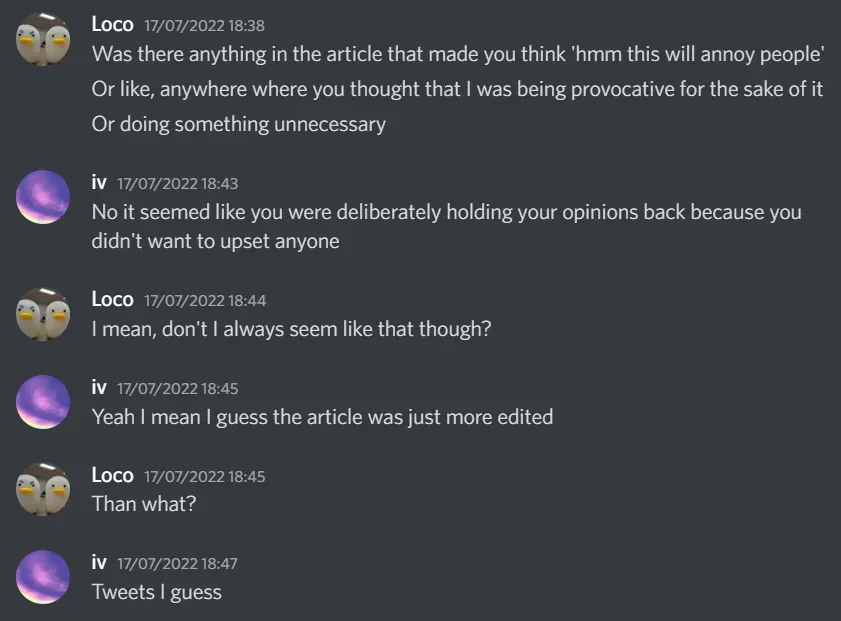
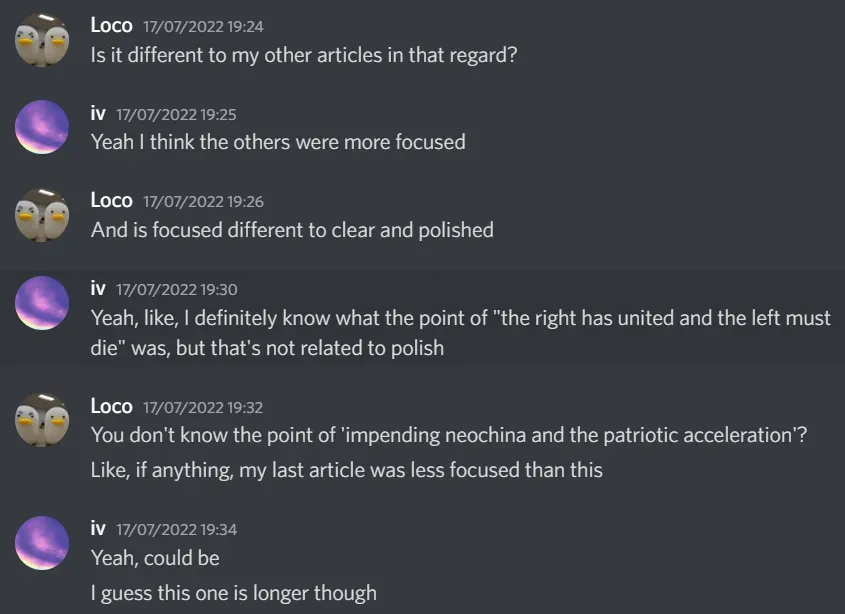
    The last post required by far the most research, and it’s honestly probably the most work I’ve ever put into a piece of writing. It didn’t really get a response though. I’m not too surprised at this, given how long and dense it is, but it’s worth noting. I probed Ivy for a response the day after uploading, and this was her first major criticism:

    This one felt kind of true, honestly. I don’t think I acknowledged it at the time but I definitely didn’t go as hard as I probably could’ve done. This was the other main thing she said:

    Now, I really wasn’t sure what to make of this. After all, the post wasn’t even finished when I first uploaded it. As with my other articles, there was a frantic stimulant-influenced rush to get all the content out by when I wanted it. Maybe she just thought that because she saw how much was in the draft first? I don’t know. Anyway, there is some truth to the fact that my posts aren’t as spontaneous and off the top as I’d like. Honestly the last few paragraphs of the post felt kind of forced to me, even if they weren’t really. I just planned them in advance when I probably shouldn’t have done. By the way, the advertisement I used in the post is a private video now lol. I don’t know how to fix that, so maybe I simply won’t.

    Where do we go from here then? I’d like to look at the RW Emerson text ‘Self-Reliance’, which is actually much more fun than the text I used the first time I brought him up. I think it’s fun because it’s all about being stoic and independent and autarky, which is obviously impossible for me, as Locorum, to do. Emerson asserts that ‘it is easy in the world to live after the world’s opinion; it is easy in solitude to live after our own; but the great man is he who in the midst of the crowd keeps with perfect sweetness the independence of solitude’2. It’s like, ok dude, but what if I don’t want to be a great man? What if I simply have no choice but to do as you describe because I’m a fuckin schizoid? What then bro?

    As with before, I do appreciate where he’s coming from though. He starts off with this:

    Ah, that he could pass again into his neutrality! Who can thus avoid all pledges and, having observed, observe again from the same unaffected, unbiased, unbribable, unaffrighted innocence – must always be formidable. He would utter opinions on all passing affairs, which being seen to be not private but necessary, would sink like darts into the ear of men and put them in fear.

    This strongly resonates with me. I’ve always felt like I was never really a child, but in the same way I kind of never really grew up. And I mustn’t grow up! There is almost nothing more important to me than keeping in tune with the way, regardless of whether it entails becoming absorbed into the machinic processes of capitalism or it doesn’t. Don’t let the bastards get you down! That is the message which Locorumness delivers.

    Emerson continues with the most metal thing you’ll ever hear a 19th Century Prot say:

    On my saying, “what have I to do with the sacredness of traditions, if I live wholly from within?” my friend suggested, “but these impulses may be from below, not above.” I replied, “they do not seem to be such; but if I am the Devil’s child, I will live then from the Devil.”

    I just want to note here that this is basically why I’ve never really gotten on board the whole ‘I am an evil person that is evil’ train. I guess Luciferianism is cool, in a kind of abstract way, but I was never even a Christian to begin with. There’s no reason for me to be evil, any more than for me to be good. I was never either, and I don’t really see why I’d start conforming to either.

    Finally, I’d like to conclude with the following:

    Well, most men have bound their eyes with one or another handkerchief, and attached themselves to some one of these communities of opinion. This conformity makes them not false in a few particulars, authors of a few lies, but false in all particulars. Their every true is not quite true. Their two is not the real two, their four not the real four; so that every word they say chagrins us and we do not know where to begin to set them right.

    This is the premise of the rejection of vanguardism, and ultimately, of all partyist ideologies. Those that will not engage with the reality of a situation where it contradicts their emotionally charged perspective on it, and will actively shout me down for doing so; those who I can have no discussion with without constantly tiptoeing around phrasings which displease their ideological armour… these are people I have little energy to engage with. After all, compromise and negotiation can only be done with parties which will compromise and negotiate. I will not represent a party; I deny representation altogether! Do not represent, fight!


    Endnotes

    1. Lisa Orlando – The Asexual Manifesto (1972) ↩︎
    2. RW Emerson – Self-Reliance (1841) ↩︎

  • Impending Neo-China and the Patriotic Acceleration

    Originally published in June of 2022

    This is the age of the patriotic acceleration; the second phase in the digitisation of the production process which the neoliberal revolution birthed. This age is to be characterised by the sharp intensification of real domination over the individual by the abstract structure of domination which we know as ‘capital’. The global coronavirus pandemic response of 2020 – the crescendo of the Trump era – initiated this intensification, and ultimately defined the terms under which the control societies which have developed across the world will progress.

    In particular, Bruno Maçães identifies a technological acceleration which the Covid-19 pandemic – and the lockdowns it caused – has generated. Last year, he had an article in the Spectator titled ‘After Covid, get ready for the Great Acceleration’. The post identifies, for instance, the launch of a driverless taxi service, the computerisation of the retail industry and the encoding of messenger RNA to transform immune systems. Truly, you are made to see why he envisions a ‘new age of technological wonder’, though how there will ever be an ‘after covid’ is perhaps less clear. He mentions an artificial intelligence system which can predict the underlying physical structure of proteins, though we also can look to developments in GPT technology for an idea of how the technocapital singularity is coming along. Even the financial instability of 2020 sped up the mainstreaming of cryptocurrency.

    On another note, Hartmut Rosa sees a social acceleration which has recently been intensifying. The most obvious manifestation of this is in what he calls the ‘number of legitimate claims on you’, which has exploded since the adoption of the internet. Such claims include social media interaction, checking emails, consuming movies or reading books – the dual proliferation of consumer goods and digital media has expanded the number of claims on you to the point that you never have enough time in the day. Newtonian time has remained static, yet you must run ever-faster on the hamster wheel. This is directly relevant to the international ‘economic dynamisation’ he describes, in which a state’s levels of innovation and productivity must increase year after year for its economy not to stagnate. As he summarises, ‘no matter how fast you run this year, no matter how innovative and efficient and creative you are this year, as a collectivity, next year you have to go faster’.

    As we know, however, productivity is largely irrelevant to value. To generate the full value of a product, its production must conform to socially necessary labour time. Accelerating productivity generates material wealth, yet the standardisation of such productivity acceleration levels out any increase in value. Wages stagnate in spite of compounding productivity increases, maintaining the value per unit of time – this is the abstract domination of capital; the domination of the individual by time. Mechanisation and automation are said to have the capacity to generate large-scale reductions in labour time, however I contend that this cannot actually happen in a comprehensive way with the current paradigm of social acceleration.

    [the video which was here has since been privated]

    I would like to talk about this video. This fucking advertisement has been played so many times in the last year, and I actually cannot even describe how much I detest it. The relaxed poses of the actors, the dreamy music, the nostalgic Australian traffic light noise in the background; it’s all very consciously designed to convey to you that being an Uber Eats driver is not really a job. No, being a driver is so easy, it’s like literally riding down the street on a couch. You might as well be in bed. This is the future of work; this is what the ‘work-from-home’ acceleration which the pandemic caused has entrenched: the deliberate blurring of the boundaries between work time and recreation time. Not only that, but the blurring of the line between worker and manager. Between consistency and precarity. Marx once said that the tendency of capital is ‘always, on the one side, to create disposable time, on the other, to convert it into surplus labour’1. All hours are disposable time, and yet all hours are working time; at all times you are on the leash your company has tied to you. This is the logical conclusion of the ‘depersonalised capital’ described in my previous post.

    The ’factors of production’ typically include the subjects of labour, the instruments of labour and the labourer. A subject of labour is typically a natural resource or raw material of some kind, where an instrument of labour is an element of the built environment, such as a tool or building. The subject and instrument together constitute the ‘means of labour’, though I think an earlier iteration of this concept – described in The German Ideology – is potentially of use. Rather than subject and instrument, we see a division between ‘natural’ and ‘built’ instruments of production. I believe, in the modern world, we can also identify a digitised instrument of production. Natural production instruments are relevant to rural space, where built production instruments are human and [sub]urban. Digital production instruments, however, are virtual in nature; they generate a space of the artificial, corresponding to a postindustrial hyperfragmentation of the division of labour.

    In relation to the worker, the digitised instrument of production is the one in which every aspect of a specialised detail process is standardised and mechanised. There are still only two elements constituting the means of labour, but the contradiction between them has developed into a mechanisation, the end result of which is digitisation. The machinic systems birthed by industrial operations were the first instance of this kind of production instrument; one where the instruments of labour actively consume fuel and perform actions independent of the worker, in some sense appropriating labour from the labourer. Returning to Marx, he even directly states that ‘the development of the means of labour into machinery is not an accidental moment of capital, but is rather the historical reshaping of the traditional, inherited means of labour into a form adequate to capital.’

    To Yuk Hui, ‘technics’ encompasses general technical development, where ‘technology’ specifically refers to machinic processes leading into automation2 – hence, we can map the ‘technological’ onto digitised production. The technics/technology distinction is used to overcome the binary opposition of the natural and the technical, which reenforces the apparent supremacy of Western notions of scientific progress to any and all other epistemologies. Specifically, Hui advances a ‘cosmotechnics’ which would integrate the Ganying (感應) of Chinese cosmology with the cultural process of China’s technical development: ‘We will see later how it is this sense that leads to the development of a moral cosmology or moral metaphysics in China, which is expressed in the unification between the Heaven and the human. Importantly for our argument here, in the context of technics such unification is also expressed as the unification of Qi and Tao.’

    Hui illustrates a view of the world in which ‘beings are joined together in a cosmic order which communicates through a consciousness common to them all; and technics concerns the ability to ‘skilfully’ bring something together that resonates with this cosmic order’3. I would like to note here that this relates to the ultimate intention of Locorumness: to generate a digitised Daoism severed and spirited away from its legalistic and Confucian counterbalances; flushed into the crevices and canyons which the Gemeinwesen has dried up in. One might indeed say that the only significant mistake Jacques Camatte actually made was to confuse the technical with the machinic – or, alternatively, to make a value judgement on the advance of the former and latter combined.

    The computer, of course, represents the ultimate realisation of the machinic in relation to labour; the ultimate realisation of the digitised instrument of production. The instruments of labour relevant to virtual [computerised] space are all purely artificial. This space which the computer has created has virtualised the production process, and as such, I claim that the human security system – the ‘business enterprise’, in Veblenist terms – has been instrumentalised by capital through artificialisation. Societies of control are societies characterised by such an artificialisation, and it’s not coincidental that the reappearance of the naked Darwinian logic of the ‘free market’ coincided with their ascendence.

    With virtualisation of the production process comes economic informationisation. In nominally restructuring a society to suit the framework of a ‘knowledge economy’, one consigns that society to the uncompromising ubiquity of fact which characterises the internet. The end result of this, as has often been reserved, is not one in which the average person is more open-minded or knowledgeable in any significant sense. The internet represents a space of information consolidation governed entirely by the free-market mythology of survival of the fittest. By its very nature, then, this requires the majority of the facts which are presented on it to be fictional. In this sense, the information age has led us directly into the post-truth era of ‘alternative media’ and ‘alternative facts’ which liberals deride. Of course, liberalism is all about having your cake and eating it too.

    On this note, I’d like to explore the concept of the ‘firehose of falsehood’ as it’s used to describe Russia’s digital propaganda model. This 2016 RAND Corporation article goes over all the main points. Before we get into it, though, it seems irresponsible not to point out the perspective they’re coming from. I’m sure I don’t actually need to directly go and explain what the RAND Corporation is – the first paragraph on Wikipedia is accurate and concise enough for that purpose. Rather, I’d just like to clarify that in the article itself they explicitly direct their message to ‘NATO, the United States, or other opponents of the firehose of falsehood’. Now, I suppose that doesn’t technically contradict their ‘objective analysis, affective solutions’ slogan, but it’s interesting to note. One of the points consistently brought up in the article is that Russian propaganda ‘lacks commitment to objective reality’, and one is made to ask whether ‘objective reality’ has the same kind of definition as ‘objective analysis’ in this context.

    That old line about how ‘a lie can get half way around the world before the truth can get its pants on’ has always had a very imperialistic undertone to me. Even if the common attribution to Winston Churchill isn’t accurate, it definitely feels like something he would say. Like, imagine the implication of a British politician from a century ago saying that, when ‘half way around the world’ meant one of their colonies in Asia or Africa. These good people don’t need lies, do they? No, they need some good old objective reality! The objective reality of The Economist and of the British Broadcasting Corporation. The objective reality of MSNBC and Al Jazeera. Don’t you understand? We, the good guys, have the objective analysis of reality, and you need to learn it!

    One of the things the article appears to be disoriented about is the extent to which a Russian news broadcast might resemble an American news broadcast: ‘a broadcast that looks like a news broadcast, even if it is actually a propaganda broadcast, may be accorded the same degree of credibility as an actual news broadcast’. Unfortunately for our comrades at Rand Corp, I think the only people that actually believe that CNN is an objective source of reality these days are people that watch CNN. They go on to give their thoughts on propaganda outlets such as RT and Sputnik: ‘visually, they look like news programs, and the persons appearing on them are represented as journalists and experts, making audience members much more likely to ascribe credibility to the misinformation these sources are disseminating’. I was actually somewhat taken aback reading this. You’d think they were discussing peer-reviewed research papers or something, with the level of elitism on display. No, apparently, they just legitimately cannot comprehend propaganda in news media form which is not American.

    The main elements to consider: Russia’s digital propaganda is rapid, it is continuous, it is repetitive, and it lacks any commitment to consistency. If you have a claim repeated to you frequently enough, you’ll come to internalise it. If such a claim seems to come from a variety of sources, and from a variety of different angles, you’ll probably believe it. With enough of such claims from a certain perspective, confirmation bias almost does the rest of the work. I’m sorry sir, you have been diagnosed with terminal Russia Brain. Please stop calling for ‘Ukkkrainian genocide’, you’re not a ‘patriotic socialist’, you’re 15.

    It’s very interesting to me that Americans suddenly come to understand that the free market doesn’t exist when the subject of the media comes up. ‘We must regulate social media to stop them from deplatforming me!’ ‘We must regulate social media to stop them from spreading misinformation!’ Apparently, we can simply purge all the bots, and refute all the fake news. No, of course we can’t. That’s simply not how the internet works, much to the dismay of the baby boomer. The one thing the internet has done is to open up new avenues for proliferation of information contrary to the narratives of traditional news media. Even when media companies monopolise elements of the virtual space, social media generates entirely new spaces with new modes of engagement. In the information age, even conflict is virtualised. The terrain on which information wars are waged is that of the human mind – this is an instance of the control society’s real domination over the individual. Your task is to propagandise more effectively than the opps; to gain an advantage over them in people’s heads. A fascist spread misinformation today, did you?

    Admittedly, American libertarians are consistent enough that they do not tend to favour government regulation of social media. This video by ‘Reason TV’ describes a choice between Barack Obama and Elon Musk – between government regulation and private enterprise. It defends Musk’s intention to purchase Twitter, and his proposal for dealing with bots and fake news on the site. Ultimately, the video’s argument is boils down to ‘Obama want government regulation of Twitter (bad) but Musk want private regulation of Twitter (good)’. Of course, it’s more nuanced than that. They explain that Barack Obama supports legislation for government regulation into all social media, whereas Musk only wants to regulate Twitter. Basically, Elon Musk is less powerful than the American Government and therefore he is cool and good. A compelling argument indeed,,, not that I necessarily expect anything more from libertarianism. I hope they enjoy the ‘Mises Caucus’ takeover of their political party lmao.

    The distinction between ‘public’ and ‘private’ ownership which characterises the neoliberal interpretation of enterprise is largely fictitious in general, really. If one understands that the state is little more than the enterprise which happens to have monopolised violence in a given nation, the nation-state’s industry as a whole can be taken as a singular large-scale enterprise. A state’s relationship with the ‘free-market’ is, in essence, the level of complexity of the enterprise’s administrative structure. The market intervenes with internal operations of this enterprise by regulating the relations between companies, which can somehow internally restructure and reorient production lines entirely independent of it. The United States seeks to convolute the industries of other states by siloing off elements of their industrial enterprises with the private sector. A cornerstone of American imperial hegemony the capacity of American media, and American media outlets, to monopolise the information flows of other countries. It’s no wonder, then, that America is so protective of its traditional media outlets.

    When the market regulates what a state is allowed to do, the state is not only made to rely on private enterprise, but on informal networks and intelligence agencies. In Citizen Revised, the ACDCA states of the NSA:

    ‘Other than the National Security Act of 1959 – which mostly outlines recruitment incentives – Congress has passed no laws specifically regulating the agency or explicitly defining its mission, even though the agency’s budget surpasses that of the FBI or CIA. Increasingly, the most basic rights of Americans are defined and redefined at will by extra-legal intelligence agencies, appointees to secret courts, and wage-earning bureaucrats following secret executive orders, rather than the actions of democratically elected representatives in Congress.’

    They go on to describe the impact of what agencies connected to the government are capable of:

    ‘Because postings to social media services like Facebook or Twitter reside on the public Internet, these platforms can be used to effectively place somebody under retroactive surveillance. Should somebody at some point arouse suspicion for whatever reason, that individual’s personal history can be examined in great detail, and analysed by sophisticated pattern-detection algorithms as if that individual had been actively monitored for years.’

    You might say that I’m being hyperbolic with the ‘post-truth era’ rhetoric, but I’d like to remind you that the Australian Federal Police are now literally capable of taking control of my social media accounts to modify and delete data if they don’t like me. Like, nothing is even real lol.

    If intelligence agencies, think tanks and media networks don’t illustrate the limitations of the ‘government vs private enterprise’ lens, though, the distinction is completely obliterated in the digital sphere. For instance: whether one characterises Huawei as a ‘government’ or a ‘private’ enterprise is almost irrelevant, for we almost intuitively understand that in China, no company is truly private. Huawei’s role in the surveillance and internment of Uyghur people was utilised as justification for the recent Western sanctions on the company, but the fact is, Huawei was sanctioned because the United States knows that the Chinese state apparatus can use it for surveillance. This is just the same as how Huawei was originally promoted within China as a means of reducing dependence on Western tech companies, which China knows the American state apparatus can use for surveillance.

    This brings us to one of the two(?) main subjects of this post then: China. Why China? Well, this is the only place on earth which has constructed international financial and digital institutions which operate almost entirely independently of those in the Western World. This power – the power of the Chinese state – has almost inevitably led to the development of a new cold war between China and the United States. After all, did the War on Terror not demonstrate that even if the United States seemingly has no rivals, it will go out of its way to create them? Isn’t it funny how reactionaries suddenly switched from complaining about Muslims to complaining about Chinese people as soon as Trump’s ‘trade war’ got underway? The Huawei sanctions were part of a much broader attempt to decouple the Chinese tech industry from the American one, which has also resulted in sanctions on China’s major tech companies. As such, Beijing now seeks complete technological autonomy; from the semiconductor chips of Yangtze Memory to the lithography and ion manipulation of Naura Technology.

    Firstly, though, what is America? I contend that the ‘imperial core’ of the American Empire spans over two continental masses of land; American ideological and political hegemony is essentially total across North America, Oceania and all the ocean in between. Currently, the UK is also effectively part of the imperial core. The AUKUS deal last year reenforces this notion, but it’s also the only reality in which the United Kingdom joining the revamped Trans-Pacific Partnership makes any sense whatsoever, even if the US isn’t a member. The United States, Canada, Australia, New Zealand and the United Kingdom – the nations of the Anglosphere – also constitute the members of the ‘Five Eyes’ security pact.

    Australia, the shining beacon of nanny-state authoritarianism that it is, essentially operates as a loophole by which US intelligence agencies collect data on American citizens in ways domestic laws might prevent. The recent fuss over the Solomon Islands also highlights the extent to which Australia operates as an American vassal state – David Llewellyn-Smith even called for Australia to invade the country to prevent its government from striking a military deal with China. This only really makes sense if you understand that the Pacific Ocean has basically been American territorial waters since World War Two. Finally, the Republican insistence on using Ardern and Andrews governments as examples of authoritarian overreach also suggests that New Zealand and Victoria effectively constitute ‘Democrat states’ from the American perspective now.

    Now, what of China? Well, I don’t think the Chinese state controls an entire ocean, but it does command a significant geopolitical and ideological presence. To me, it’s blindingly obvious the extent to which the ‘Socialism with Chinese Characteristics’ we see today maps onto the ‘socialism’ of Western labour parties in the 20th Century. That is to say that it is a xenophobic, bourgeois force of vulgar productivism reliant on the displacement of indigenous peoples and the exploitation of third world countries. The global manufacturing base has shifted, and with it, the pretence at an internationalist progressivism which its new wealth allows for. China has an upper hand in this regard: where America merely seeks to cut itself off from China, China seeks to market its products to the rest of the world.

    However, I don’t seek to merely oversimplify China’s current existence to the extent I just did and leave it at that. Here, Chuang describes a sense in which the Chinese state has historically been mystified and objectified to fit the Westerner’s narrow, universalist ideological lens, and I do not seek to perpetuate this:4

    ‘Propaganda is examined as if it were matter-of-fact description of the industrial system. Model factories are described as if they mirror the real thing. The mythos of Chinese socialism is expected to match up, one-for-one, with the actual composition of Chinese society. China again becomes a sort of mirage, this time reformatted for the new coordinates of the Cold War. The result is a Potemkin Village version of socialist China, by one side vilified and by the other held up as one of the only flickering lights in the darkness of a century lost.’

    This criticism is elaborated on later in the text:5

    ‘Originally published as the Fundamentals of Political Economy in Shanghai in 1974, during the peak of state influence during the “long” Cultural Revolution, the book was meant as a summary of Party ideology at the time. Ostensibly describing “socialist political economy” as theorized and practiced in China, the textbook was translated and published, with accompanying essays, by American Maoists under the name Maoist Economics and the Revolutionary Road to Socialism: The Shanghai Textbook. The textbook, alongside other collections of state propaganda and reports from foreigners’ tours of model factories, has been taken as a common reference point for both supporters and detractors.’

    Chuang suggests that the book is little more than a ‘sort of religious text’, and that its reliance on brief glimpses of model enterprises and readings of state propaganda reflects a general Western experience which would reenforce the ‘holy status of such texts for Western radicals’. This kind of obscuring might seem to be an issue only relevant to the 20th Century, when information regarding the internal affairs of the PRC was scarce, and was often produced by the Communist Party itself. However, it seems to me that Western analyses of China continue to be overly opaque and orientalist in nature. As with other parts of the world, China is reduced to little more than a conceptual game to support whatever point you’re making.

    Jiang Shigong, a pro-Communist Party intellectual, uses Xi Jinping’s Report to the Nineteenth Party Congress as a basis to define and periodise the history of the Chinese state:

    ‘”Standing up” (站起来), “getting rich” (富起来), and “becoming strong” (强起来) are ways to divide the histories of our Party and our Republic, referring respectively to the Mao Zedong era, the Deng Xiaoping era, and the Xi Jinping era that we are currently entering. These divisions are not those understood by academic historians but must be analysed from a political angle. Using historical divisions to express political thought is a basic method employed by traditional Chinese philosophy.’

    The first two eras roughly correspond to economic periods which historians identify in Western history: the ‘Standing Up’ era of Mao Zedong aligns with the Keynesian postwar consensus, where the ‘getting rich’ era of Deng Xiaoping corresponds to the economic liberalisation of free-marketism. If we connect 60s countercultural forces to Mao’s Cultural Revolution, we can even make the case that the origins of Deng Xiaoping’s reform era are structurally or libidinally aligned to the Neoliberal Revolution. The third era, however – Xi Jinping’s ‘becoming strong’ era – only makes sense in the context of the ‘patriotic acceleration’ which I describe.

    I’m not content with simply pretending that China is on the same page as the West, though. Jiang notes that ‘the “getting rich” era of ‘socialism with Chinese characteristics’ is described by the Communist Party as “following the tide of the times”’, but it was fundamentally not of the same character as Angloid Thatcherism. Returning to Chuang, they remind us that ‘given the absence of capitalist accumulation imperatives and the rural-heavy demographics of the country, no truly proletarian class was produced in the socialist era’ (5). Neoliberalism has been characterised by the disintegration of the Western proletariat, but it’s only been in this period that a Chinese proletariat has been allowed to develop. Consequently, ‘Xi Jinping Thought on Socialism with Chinese Characteristics for a New Era’ (习近平新时代中国特色社会主义思想) simply cannot be equivocated to American Trumpism in any meaningful sense (imo).

    Ultimately, the American exit from the TPP set off the signal East Asia needed. This was the indication that America will no longer even pretend to support the economic development of Asian economies, and especially their integration into the Western trade system, regardless of whether China is involved or not. East Asian countries now pursue economic integration with one another – and with China – to balance out the lack of American interest. The Regional Comprehensive Economic Partnership free trade agreement which every major East Asian economy signed onto in 2020 is all the evidence anyone needs of this. China’s export-oriented economy, and consequent reliance on capital inflows, prevents it from untethering from global markets. It’s simply a safer bet for regional powers than whatever the American economy is. This also distinguishes it from the antagonist of the original Cold War, the USSR: the Soviet Empire was uniquely economically closed and self-sufficient, allowing people to chart its rise and fall much more accurately than they’d be able to do for China.

    2020 was also an extremely good year for the Chinese economy. Increased capital inflows brought up the weighting of Chinese securities, as well as securing favourable interest rates. The Financial Times declared that ‘despite a global coronavirus pandemic that began in China, 2020 has transformed into the year it all came together for the country’s capital markets, as foreign investors snapped up more than Rmb1tn worth of stocks and bonds’. By the middle of the year, China’s Cross-Border Interbank Payment System – a scheme transparently aimed at globalising the Yuan’s influence – had secured the participation of ‘984 financial institutions — 48 more than at the end of 2019 — from 97 countries and regions’. The majority of these participants are Asian, and rather significantly include major Japanese banks.

    I don’t think this means that the RMB will somehow supplant the dollar as the global reserve currency, though. In this rather well-written article, Kathleen Tyson points out that ‘the renminbi is not free-floating or easily converted to other currencies’, and that ‘countries receiving early renminbi [Belt and Road] loans immediately swapped into dollars’. This is where the digital RMB comes in, however. China may have cracked down on cryptocurrency, but it’s gotten much closer to rolling out its own digitised form of currency than other places – by the way, digital currencies will likely be directly linked to your identity, constituting something comparable to food stamps or vouchers. This currency could potentially become a significant force in East Asia, first targeting what Tyson describes as the ‘Ant and Tencent payments duopoly within China’, and then moving into global supply chains. This future isn’t certain, though. Even Japan is considering its own digital currency, and the ‘wolf warrior’ diplomacy and aggressive military posturing which has characterised the Xi Jinping era seems to be at odds with Beijing’s aim of economic integration with other Asian powers. The expansion of the ‘Digital Yuan’ would be directly facilitated by American economic isolationism and spiralling Western inflation.

    In the United States, the political dominance of populist nationalism over liberal internationalism was thoroughly established with the 2016 election, and this has not shifted significantly at all under Joe Biden. The Biden Administration, particularly in terms of foreign policy, is defined in purely Trumpian terms. It’s not only that the United States has accelerated the economic decoupling with China, but also that it hasn’t even attempted to re-join or propose an alternative to the TPP. It’s not unlikely that the unfavourable economic circumstances Biden faces will lead to the re-election of Donald Trump in 2024, spelling out an effective 12-year period of continual Trump Administration.

    Where one might once have conceived of the global predominance of free-market capitalism – as seen at the end of the 20th Century – as a universalisation of political life, from our current vantage point we can see that it was only the base structure from which a new nationalism fragments the planet into a set of economic blocs. Unlike the nationalism which the height of colonialism spawned, however, this is one which will be potentially underpinned by a genuine competition between different cultural and racial identities. In the Anglosphere, this is highlighted by the increasing antagonism of the general populous to people of East Asian ancestry. Violence against Asians is now a common occurrence in many major American cities, and in Australia, it’s basically socially acceptable to complain about how ‘the Chinese are buying up all the property’ or some other such nonsense. Just last week there was yet another 60 Minutes episode about how ‘the Choinees are on your doorstep’. I did not watch it, but I can only hope that it doesn’t implicitly suggest building Chinese internment camps like this one did.

    Hopefully by now it is clear exactly what I mean when I say that this era is one of patriotic acceleration. It is the wet dream of the ‘patriotic socialist’; the fantasy of the sun-worshipping ‘fourth positionist’. An international regression into nationalist tendencies with the Communist Party of China at the helm of global technological advancement. Liberals of both the Western and Eastern varieties pursue a technologically driven society of nuclear-powered efficiency, neohumanist eugenics and unconstrained surveillance. They just don’t like each other. Simple as.

    Russian influences have proliferated in the Indian media under the Modi Government, which has deepened the ties between Russian, Indian and American nationalists. The Philippines literally just elected the son of Ferdinand Marcos as president – as if Duterte wasn’t enough. Erdogan’s continual occupation of parts of Northern Syria highlights the extent to which Turkish nationalism is not constrained by ‘international law’. The Arab Spring protests across North Africa in 2011 almost foreshadowed the 2021 round of military coups in the Sahel region, from Mali to Guinea to Sudan. The ways the American Government sought to justify military intervention in Syria following events of the Arab Spring was quite ridiculous also. Just a small no-fly zone. Just a little targeted strike. A quick in-out trip. 20 minutes. Trust me.

    These days they sell Coke without calories, milk no fat, war without casualties – Vents, FTM

    There’s a stunning level of whataboutism which Western rightists tend to engage in now, where you are literally not permitted to bring up classical fascism or national socialism without being asked ‘what about communism?’ or ‘what about China?’ Of course, it is quite clear that one could only really be so reluctant to discuss fascism in isolation is due to one’s sympathies for fascism. No, you can’t talk about that, you must relativise and trivialise! It’s just the same as the disregard for the lives of people in Ukraine which leads sun worshippers to be unable to discuss the current invasion in isolation. It’s all tribal. It’s all a game. None of this is about stuff that actually happens; nobody actually cares.

    The new international nationalist dynamic is evidenced also by how – once it was realised how little verbal ‘support’ amounts to in the context of a conflict on the other side of the world – liberal signalling regarding the war in Ukraine rapidly devolved into explicit Russophobia and accompanying Aryanisation of White Ukrainians. The strangest thing to me was that, prior to the conflict, I’d always had a suspicion that I had some kind of irrational distaste for Russian culture. In hindsight, it seems that it was likely just reasonable concern about Russia’s fascistic political climate – not that I’m under the illusion that other Eastern European states don’t have a similar thing going on. We must remember that Russia’s particular brand of aggressive revanchism, however, is not limited to peoples outside of its borders. We already know about the indiscriminate shelling, shooting and rape which occurred in Chechnya. What is now occurring in Ukraine was earlier practiced within Russia itself.

    You might be tempted to suggest that the neonationalism which is now becoming ubiquitous contradicts the advance of technocapital. After all, capital itself is nothing if not a continual revolt against traditional forms of life, isn’t it? Since the development of fascism in the early 20th Century, however, capitalism been able to surgically dissect and wear down every revolt against order to appropriate and repurpose it for its own ends. Under the fascist’s ultranationalism, the state makes a show of its monopoly on violence for the purpose of reintegrating a disenfranchised proletarian class in such a way as to maintain the property relations they would otherwise look to supersede. Fascism is a cynical reactionary reconfiguration of socialism, in just the same sense as ‘laissez-faire’ economics is a cynical reconfiguration of anarchism, and organised religion is a cynical reconfiguration of mysticism. In the control society, such mirror reconfigurations of genuine ideological positions have successfully monopolised political discourse.

    Yet, this is the very nature of electoral politics. Pressurised forces of political agitation are piped into the security system and redirected towards periodic events of electoral spectacle, in which power is symbolically transferred from one oligarchic commercialist junta to the other. The pressure is vented out through these events, in which the party which has been ruling, and has thereby been designated as the old party of the old socio-economic status quo, is supplanted by the new faces and new ideas of the ostensibly new party. Yet, you cannot vote to dismantle the technocratic think tanks which promote eugenics and nuclear warfare. You cannot vote the police out of their vans and stations. You cannot vote for the destruction of the prisons. But, after all, spare the gaol, spoil the gaoled! Can’t have that, can we?

    I think what the Biden Administration’s Starmer-Albanese-Pelosi axis of liberalism evidences, though, is the extent to which you can’t expect electoralism to even maintain what you have. Your rent will be raised! You will marry that man! You will birth that child! You have nowhere to hide;; whether you be shopping or playing sports game or crossing border, you will have your body inspected and your face recorded! These are non-negotiable terms of the populist age, you understand? Even when the government isn’t violating your bodily autonomy, a private citizen who doesn’t approve of your existence might well do so. Even where the government hasn’t recorded your presence in a public space, someone taking a film on their phone probably has. Please wear a mask in public places.

    Leftists will claim to be disgusted by this state of affairs, and yet somehow, they only ever seem to be capable of criticising authority for not being efficient enough. The Leninist party of the revolution will simply be completely different to the other parties, of course. I like to make this point often, but it’s very important to highlight the hypocrisy of their authoritarianism in connexion with issues they profess to care about. Of course, I have been in particular alluding to abortion in the wake of the US Supreme Court decision against Roe vs Wade. Now, firstly, if you think Brandon signing an executive order is the end of story there, I have a bridge to sell you – but also: the Supreme Court has expressed interest in a number of other issues which he most certainly will not respond to. In particular, this case concerning the Indian Child Welfare Act of 1978 will be reviewed, and for some reason I don’t have very much confidence that they’ll side with Native American tribal sovereignty. As we know, settler-colonial states have a knack for finding ways to tear children out of indigenous communities.

    In this environment, I will not negotiate with lazy strawmen of the different identitarianisms. Trans advocacy entails the exclusion of non-binary people? Black nationalism entails a literal separatist nation-state which excludes non-blacks?? Land back movements entail mass deportations and genocide of non-indigenous peoples??? Why on earth would anyone want to hear from you if you believe this? No investigation, no right to speak! This is not to say that I’m unfailingly loyal to any preacher of any form of identity politics, of course. Racketeering grifters love to claim these causes, and formal groupings dedicated to them will invariably and rapidly trend towards their most reactionary constituencies. I think this is important to note specifically because there is a depressingly common tendency to make every excuse for politics which would apparently benefit one’s own identity whilst actively antagonising anything which apparently doesn’t. I don’t understand why it’s so hard to stay out of other people’s business.

    THIS JUST IN, SHOCKING 6-3 SUPREME COURT RULING: CHEMICAL WARFARE, CHEMICAL WARFARE, CHEMICAL WARFARE, WARFARE WARFARE! Please wear a mask in public places.

    I don’t think people necessarily tend to understand what I mean when I compare myself to anarchists. I am not ontologically anarchist. I don’t come to you with such extraneous questions as ‘should the global economy collapse’, I come with the expectation that it will. The question is not whether there should be crisis, but what opportunities you can take from Crisis when she comes. Of all the things discussed in this article, I literally haven’t even mentioned the coming economic crash, which is surely inevitable. What will you do when the American Empire collapses, its vassals are plunged into turmoil, and the people are subsumed by political repression, social instability and ecological devastation? Where will you be when the losses of your brothers and sisters, of the destitute, the disabled and the queer, hastens from a slow trickle into rivers of blood? We do not have time for children of the bourgeois ordering one another around with their make believe ‘shoulds’ and ‘should nots’! We don’t have a moment to waste!!

    As much as I dislike them, I think the Beatles were ultimately correct in their diagnosis of the direction of the modern world. Here comes the sun. Doo doo doo doo. But it’s not alright. The kids aren’t alright. To my mind, that is our only recourse.


    Endnotes

    1. Karl Marx – ‘Fragment on Machines’ (1858) ↩︎
    2. Yuk Hui – ‘Cosmos, Cosmology, and Cosmotechnics’ in ‘The Question Concerning Technology in China’ (2016) ↩︎
    3. Yuk Hui – ‘Dao and Cosmos: The Principle of the Moral’ in ‘The Question Concerning Technology in China’ (2016) ↩︎
    4. Chuang – ‘Sorghum and Steel: Transitions’ in ‘Dead Generations’ (2020) ↩︎
    5. Chuang – ‘Sorghum and Steel: Ossification’ in ‘Dead Generations’ (2020) ↩︎

  • Technocratic Whigs and Collateral Damage

    Originally published in March of 2022

    To me, one of the most interesting aspects of the premiership of Robert Walpole is his brand of isolationism. For the two decades his ministry was in power, they essentially kept Britain’s hands clean of the goings on of mainland Europe. This was popular with the public because it allowed them to keep taxes low and to focus on domestic affairs. Though Walpole was personally a stock-trading capitalist, he was also deeply embedded within the landed gentry. As one might expect, his aristocratic background ultimately determined his economic views: in essence, he wanted to use the reduction of national debt to replace the land tax with tariffs and excise taxes on Britain’s increasingly powerful merchant class.

    How would one describe this form of mercantilism today, though? Populist? Nationalist? Reactionary? Indeed, a recent American president comes to mind. What I find fascinating is the extent to which Walpole is praised by British academia. He’s commonly considered to be the first prime minister of the UK– and certainly one of the least controversial – but I think what’s more relevant here is that he was the first Whig prime minister. Because, really, I don’t believe there’s any point in history at which a self-important aristocrat acting in the interests of the aristocracy can be described as anything other than reactionary. Maybe that’s just me though, idk. After all, he wasn’t a Tory.

    The implied position here is that the Whigs were the good guys back then, but are no longer the good guys because those ideas are outdated now. Society has progressed past the need for Whigs. I think someone even wrote a book about it. As you’ll no doubt be aware, this understanding of history is commonplace across academia and political discourse today. You know, vulgar progressivism. The Whig interpretation of history. Line go up, etc.

    This sentiment is echoed in Jimmy Carter’s infamous 1979 Crisis of Confidence speech:

    ‘Confidence in the future has supported everything else — public institutions and private enterprise, our own families, and the very Constitution of the United States. Confidence has defined our course and has served as a link between generations. We’ve always believed in something called progress. We’ve always had a faith that the days of our children would be better than our own.’

    The ‘crisis of confidence’ here relates to the sense in which American society was confronted at once by stagflation and an energy crisis. Carter attempts to square his (quite literally) religious faith in progress with the reality on the ground; that of falling productivity, rising inflation, high unemployment and low social cohesion.

    ‘We always believed that we were part of a great movement of humanity itself called democracy, involved in the search for freedom; and that belief has always strengthened us in our purpose. But just as we are losing our confidence in the future, we are also beginning to close the door on our past.’

    ‘In a nation that was proud of hard work, strong families, close-knit communities, and our faith in God, too many of us now tend to worship self-indulgence and consumption. Human identity is no longer defined by what one does, but by what one owns. But we’ve discovered that owning things and consuming things does not satisfy our longing for meaning.’

    Thank you, Mr Peterson. I think the following is really the essence of the speech, though:

    ‘We are at a turning point in our history. There are two paths to choose. One is a path I’ve warned about tonight, the path that leads to fragmentation and self-interest. Down that road lies a mistaken idea of freedom, the right to grasp for ourselves some advantage over others. That path would be one of constant conflict between narrow interests ending in chaos and immobility. It is a certain route to failure. All the traditions of our past, all the lessons of our heritage, all the promises of our future point to another path — the path of common purpose and the restoration of American values. That path leads to true freedom for our nation and ourselves.’

    I really can’t overstate the extent to which this invokes not only modern social progressivism, but also classic Protestant American idealism – and of course, it’s not coincidental that they mech so well. For comparison, this is RW Emerson in the 1830s:1

    ‘When simplicity of character and the sovereignty of ideas is broken up by the prevalence of secondary desires, – the desire of riches, of pleasure, of power, and of praise, – and duplicity and falsehood take place of simplicity and truth, the power over nature as an interpreter of the will is in a degree lost; new imagery ceases to be created, and old words are perverted to stand for things which are not; a paper currency is employed, when there is no bullion in the vaults.’

    If you’ll indulge me just once more, I think Carter makes his understanding of history yet more stark in the 1980 Carter-Reagan presidential debate – he puts a full stop on the social security discussion with this statement:

    ‘These commitments that the Democratic Party has historically made to the working families of this nation have been extremely important to the growth in their stature and in a better quality of life for them. I noticed recently that Governor Reagan frequently quotes Democratic presidents in his acceptance address. I have never heard a candidate for President, who is a Republican, quote a Republican president, but when they get in office, they try to govern like Republicans. So, it is good for the American people to remember that there is a sharp basic historical difference between Governor Reagan and me on these crucial issues – also, between the two parties that we represent.’

    Here, he alludes to the legacy of the Democratic Party as it stood in 1980: that of the social paradigm introduced by one Franklin Delano Roosevelt following the Great Depression. The paradigm of social democracy, which was established by New Deal progressivism and maintained by the political establishment from the 40s to the 70s. The social democratic era which began with Roosevelt and ended with Carter.

    So, let’s start at the beginning then: the 1930s. Why not? I’d like to draw your attention to a particular ideological influence on the Roosevelt Administration which tends to be swept under the rug by all but the most naïve Republican partisans; an ideological influence which took the world by storm in the leadup to World War Two. Indeed, these days people are often more than willing to acknowledge the extent to which Soviet authoritarianism, Kuomintang nationalism or even good old-fashioned Churchill-style one nation conservatism resembles old school corporatist fascism, but if we turn that cynicism in towards none other than that great bastion of liberty and democracy, the United States, I contend that there’s more than a vague resemblance.

    This is the logo of the NRA. No, not that NRA. The National Recovery Administration. This agency represented a significant aspect of the Roosevelt Administration’s goal of bringing labour and industry under the direct influence of the federal government (and later, the subservience of the military). Unrelated, but as we know the administration also set up Japanese American internment camps in the war. Also, the administration worked diligently to promote traditional gender roles and the ideal of the nuclear family, thereby laying the groundwork for the modernist 1950s White America aesthetic we all know and love. Also, FDR ran on a populist political platform against the New York elites and for the American people. Also, FDR was elected four times where previously no president had served more than two terms.

    Now, none of these alsos in isolation necessarily mean very much, but if you put all the pieces together, I’m sure you can see what I’m getting at. Like, honestly. I don’t think it was an accident that the United States only entered World War Two after they literally got bombed. But why don’t people discuss this? Why isn’t it ever seriously entertained in mainstream political discourse that the Roosevelt Administration mightn’t have been particularly anti-Mussolini? We all know the answer, at least implicitly. FDR has been retroactively declared a hero of liberal democracy to justify the Whig view of history.


    The postwar social democratic consensus was never particularly stable, of course; I’d even contend that it was in a continuous state of breaking down. I think I spent enough time on this issue in the last post, though – something something counterculture May 68 libidinal impulse. Blah blah blah. Let’s move on from there: social democracy’s dissolution into society has allowed for the development of a capital wholly depersonalised, assetless and reliant on speculation. The development of the ‘red tribe blue tribe’ city-country contradiction launches a capital independent of private property. Marx and Engels state that ‘the separation of town and country can also be understood as the separation of capital and landed property, as the beginning of the existence and development of capital independent of landed property – the beginning of property having its basis only in labour and exchange.’2

    Whilst the business enterprise is the site of the production process, it also restricts movement of capital – if the fixed character of the enterprise can be overcome, there can arise an autonomous form of capital based on what Camatte and Collu term a ‘mystical yield form of surplus value’3, and on corporate promotion, stock issuance and speculation. The development of a private production independent of private property, and of a capitalism without capitalists. Capital’s valourisation leads it to confront the social ensemble and the rival rackets which it must necessarily compete with to differentiate itself; ‘the state itself had to lose its rigidity and become a gang negotiating between gangs and between the total capital and particular capitals’. They go on to say that ‘all forms of working-class political organisation have disappeared. In their place, gangs confront one another in an obscene competition, veritable rackets rivalling each other in what they peddle but identical in their essence.’

    I still find it hard to stomach that Australian Laborites have the tenacity to complain that workers often consider unions to be corrupted, white-collar entities, considering the parliamentary Labor Party deliberately centralised and disarmed them through the bureaucratic nightmare of the ACTU only to render them utterly irrelevant with the introduction of enterprise bargaining and the Prices and Incomes Accord. This is just one side of the coin with social democracy in the modern world, though.

    The central premise of economic liberalisation was comprehensively disproven in 2008: economic markets were evidently not self-correcting, for why did the CEOs of banks, brokerages and insurance companies turn to the American Government, and why were world governments bailing major banks out; injecting capital into them and guaranteeing their deposits? These governments were not letting the market sort itself out, they were borrowing heavily and stimulating demand a la John Maynard Keynes. The entire Chicago School mythology of neoliberalism was demonstrated to be paper thin. In the aftermath of the Global Financial Crisis, none other than Alan Greenspan – the very same dude who fervently opposed regulation of the derivatives market because it was central to spreading risk around or some shit – conceded that he was in a ‘shocked state of disbelief’ regarding the ideological implications of the event.

    In another text, Camatte opines that capital has escaped its economic confines, and that humans tend to be ‘outstripped by the movement of capital’4. I can hear the nodding of heads here. Indeed, capital is a dynamic subject, and a structure of abstract domination increasingly independent of human will. The compoundingly complex restructuring of reterrritorialisation rendered Leninist planism obsolete. As the productive forces continually developed, and as the commodity form was superseded, Mao and Stalin remained in place, necessarily working with technologies which had already been developed. One might well bring forth the idea that the productive forces eventually come in to contradiction with the existing form of intercourse, resulting in social revolutions which do away with alienation. As Camatte clarifies, however: ‘this was to presuppose that capital would not be able to become truly autonomous, that it could not escape from the constraints of the social and economic base on which it is built: the law of value, the exchange of capital and labour power, the rigorous general equivalent (gold), and so on.’

    Related: Marxists would have you believe the categories of Marxian political economy (commodity, surplus value, capital, etc.) are merely economic categories to be used in demonstrating the centrality of class exploitation, and thereby in affirming labour as the source of all social wealth in all societies ever. Capitalism is simply when labour is hindered from becoming fully realised – and when labour is openly treated as the regulating principle of society, that’s socialism. Of course, most wouldn’t necessarily admit to this. After all, anyone that’s done much reading at all will recall that Marx explicitly takes issue with the first proclamation of the Gotha Program, instead attributing wealth to nature5. However, the implication of most Western Marxist worldviews is what I’ve said. Indeed, leftists still have not progressed beyond Stalinism and social democracy.

    Social and structural changes in the modern world are grounded by constraints historically specific to capitalist modernity, and the heteronomous dynamic which categorises capitalism is the only one in which the categories of Marx’s political economy are of relevance. Labour is not transhistorical, and it cannot be the source of all wealth. Labour is a concept relevant to all of history, of course, but it takes on a historically particular form in capitalism; a form of social mediation that marks the social relations of capitalism, and isn’t at all intrinsic to labour itself.

    History is not dialectical, and it is not progressive. One shouldn’t necessarily take this to mean that I’m willing to put contingency forward as ontologically central, however, as that might well serve to obscure the development of capital through recovering a sense of historical agency. I’m simply on the Postone train insofar as this issue is concerned: I don’t believe one can build a coherent and transhistorically valid theory of history and society from Marx’s mature works. Learned Marxists will argue that their position on feudalism distinguishes them from progressives, insofar as they consider it to be a loss of momentum from previous modes of production. I don’t think that’s really relevant though. At the end of the day, Marxian progressivism defaulting to the Whig position has blindsided communism to a reactionary lurch backwards: the neoliberal turn of capital.

    The progressive worldview also entirely fails to account for the hastening superfluity of proletarian labour in the modern world. I think that ‘all labour is skilled labour’ bullshit from a few months back really brings this home. The idea that analytic distinctions between different forms of labour can be confused for moralistic judgements is quite amazing to me, honestly. It’s as though a caricature of a businessman with a monocle and a top hat was attempting to understand the motivations of the working class… ‘well, they surely must enjoy the skills they’ve been made to learn here, otherwise they’d simply buy a house.’ This is the most blatantly moralistic conception of capitalism; that le capitalist pigs are an evil force acting against this virtuous abstraction of a worker we’ve just gone and reified.

    In reality:

    Capital’s universalisation has resulted in real domination over the individual.

    Instruments of production, be they natural, built or digitised, contribute to abstract structures of domination.

    Societies of control exacerbate the increasing fragmentation of individual labour and entrench the poverty of alienation of the individual.

    The disintegration of consciousness pulls at increasingly individuated strands of critique – be it the Black liberation of Huey Newton, the anti-psychiatry of RD Laing or the cyber-feminism of Sadie Plant.

    The informationisation phase of economic development has only consolidated the gains of the Neoliberal Revolution; the phallocratic net of patriarchal social relations was not lasered apart by the maternal glow of digitisation.

    Them’s the facts tbh.


    Shiny and current bottle-of-easy-answers solutions to the social malaise of the proletariat seem to come into fashion every once in a while– you know the ones. Healthcare pls. A land tax would solve this. Society if universal basic income. Each of these examples, but the first especially, really just come back to arguments about reformism. I’m willing to concede that, as with universal healthcare, the introduction of a land value tax might potentially benefit most people in some way, if you assume that there are exemptions for indigenous peoples and food production and stuff. I don’t know, I’m not an economist lol.

    In terms of ‘universal basic income’, the question of what that term actually entails is paramount. Studies such as this one here tend to conclude that a basic income which isn’t conditional or means tested ‘doesn’t seem to provide a disincentive for people to work’ and ‘boosts recipients’ mental and financial well-being, as well as modestly improving employment’. However, this is in a vacuum with no way of accounting for the broader societal response, or even the amount of money which would be doled out. As was exemplified by Andrew Yang’s ‘Freedom Dividend’ proposal, practical implementation of UBI would not simply constitute an additional welfare program, but would act as a blanket replacement – and not a replacement anyone could afford to live off of, either. This from the Yang campaign website:

    ‘Andrew proposes funding the Freedom Dividend by consolidating some welfare programs and implementing a Value Added Tax of 10 percent. Current welfare and social program beneficiaries would be given a choice between their current benefits or $1,000 cash unconditionally – most would prefer cash with no restriction.’

    So, there you have it. Not only is the basic income not particularly universal at all, but prior to any attempt at implementation whatsoever, it’s quite explicitly a scheme to strip specialised welfare programs down funded by regressive taxation. An excuse to knock off a few more of those pesky lumpenproles and disabled people, because clearly the current lack of medical coverage doesn’t kill enough of them as is. And honestly, of course that’s what it is. Of course it’s a means of streamlining neoliberal austerity and an excuse to jack up the rent and bills. Is it just a coincidence that none other than Elon Musk himself has expressed support for this proposal?

    Basic income is commonly advertised as a short-term solution to automation of the workforce, and it makes you wonder whether this apparently spontaneous process is supposed to be a positive development or not. I get the impression a kind of motte-and-bailey antihumanism is the response to be deployed for this line of questioning, at least by more experienced technophiles. They often seemingly fail to comprehend the incompatibility of all of the forms of eugenics they champion too, though. If, as a consequence of automation and scientific development, the workforce will shrink and the retired population will expand, you don’t want a higher birth rate, right? Like to be consistently progressive, you cannot champion fascistic pro-natalist political policies, yeah? Yet, I’ve most certainly seen technological developments such as artificial wombs advertised as potential tools to ‘prop up the birth rate’.

    The implied justification of automation – that it would cut work hours down – is intrinsically linked to the implied justification of Western liberalism as a whole: that it would function without inequality. The fact is, the way in which the rights and freedoms of liberalism are expanded, and in which demographics are ‘enfranchised’, necessarily conserves structures of domination. People maintain wealth due to social status, rather than maintaining social status due to wealth. Freed slaves are not quite citizens; third world nations plugged into global trade are not quite democracies.

    This brings us to the International Monetary Fund. Frankly, it was a bank set up to lock down the trading interests of the recovering imperial pow– I mean, the democracies which emerged from the ashes of the Second World War. A bank which any emerging nation-state could count on for short-term loans at full interest to finance development wink wink. If we jump forward, the 1973 oil crisis, among other factors, rendered numerous ‘developing’ economies unable to sustain themselves without banking loans, indebting them indefinitely to the IMF. This allowed the developed world, in conjunction with the IMF, to strip down tariff and other trade barriers in these states and to comprehensively integrate them into the emerging global economy (devaluation of currency and decimation of local agriculture and industry being completely unintended knock-on effects, of course).

    The immense contraction which the Indonesian economy experienced as a result of the Asian Financial Crisis was, as one might expect, only exacerbated by the deals the government made with the IMF. The rest of East Asia took note of this event, and their reluctance to trust Western financial institutions led to increasingly export-oriented economies and large exchange reserves. As such, by the mid-2000s, there was a storm of several trillion dollars of currency reserve around the world. The developed countries with advanced credit systems weren’t borrowing sufficient savings, and the savings of developing countries were channelled into developed ones via the inconsistently regulated companies involved in doling out securitised mortgages on American housing. As we know, prior to 2008, Americans assumed that house prices wouldn’t fall. Those with mortgages they couldn’t afford were simply expected to refinance, re-mortgage, get into more debt and keep paying it off. The rest is history, really.

    We return to malding about how Keynesian intervention is suddenly relevant again when it’s about banks. The interventionist impulse of social democracy has been successfully spirited up and reconfigured to suit control societies. Indeed, the openly authoritarian ideological underpinnings of New Deal progressivism laid the foundations of modern liberalism. Whether your child isn’t learning enough, or your minorities are scary, or your geopolitical rival isn’t complying, or your economy is on the verge of collapse – the answer is never any kind of serious overhaul or restructure, it’s just ‘intervene more’. A bit more control. Just a little more power. Trust me. This is why that specific kind of person I’m invoking is so fond of organisations along the lines of the United Nations and the European Union. Russian proponents of the Soviet Union would never have identified themselves in the same terms, of course, but it was always the same kind of person there as well.

    Here, you may be prepared to wheel out the ‘it wasn’t real communism haha’, ‘everyone I don’t like is a liberal’ line of snark, but let me pre-empt you. I will concede right here: not all Stalinists are liberals. No, many are much worse. What we can conclusively state, however, is that all liberals are Stalinists.

    Let me turn to a specific instance of liberal democratic social intervention. For the majority of Australian history, Indigenous Australians have been assaulted by a policy of racial assimilation aimed at them. Arguably, this approach was gradually phased out, with the emphasis shifting to ‘cultural integration’ and then ‘self-determination’ in the latter half of the 20th Century. Once or twice growing up I heard people make statements along the lines of ‘the Stolen Generations never ended’, and I didn’t really get what they meant. Now, independent of the way rural Aboriginal communities are treated by the police and the authorities more broadly, and of the fact that racial segregation never really subsided in a number of places, I think the following information really puts things into perspective.

    From the Royal Commission into Aboriginal Deaths in Custody in 1991 to the ‘Bringing them Home’ report of the Human Rights and Equal Opportunity Commission in 1997, the impact which decades upon decades of disruption, displacement and desertion of Indigenous people at the hands of the Australian state left on the capacity of Aboriginal communities to support children was highlighted. In spite of this, a sudden storm of media coverage and investigation into abuse and neglect of Aboriginal children in 2006 was what caught the attention of the Howard Government. This frenzy provided them with a prime excuse for execution of a sharp and heavy-handed project of Indigenous exploitation; assimilationist stereotypes about the incapacity of the Black man to care for his children had been reinforced in the minds of the public, and there was a demand for action.

    The emergency intervention into the Northern Territory, now commonly known simply as ‘The Intervention’, was an explicitly imperial and paternalistic White supremacist action, as is highlighted when Pat Anderson states that ‘where we emphasised the need for resources and flexible processes of engagement with Aboriginal families and communities, the intervention emphasised external control and blanket provisions affecting all Aboriginal people.’ She goes on to describe specific elements of the intervention:

    ‘Compulsory health checks of Aboriginal children to check for ‘evidence of abuse’, blanket quarantine of welfare payments to all Aboriginal people, leading to suspension of the Racial Discrimination Act, plus the compulsory acquisition of Aboriginal townships and the scrapping of the permit system that allowed Aboriginal people at least some control over access to their land.’

    You won’t hear a word about this event today, presumably because most Australians still quietly agree with what the government did. This is nothing new, of course. Most Australians implicitly affirm that the Indigenous incarceration rate being almost ten times higher than the non-Indigenous rate is fine. The very same people banging their utensils on the table agitating for lockdown curfews and increased police budgets will signal about how much they care for the plight of marginalised demographics.

    This is what I hate about the Whig interpretation of history, though. Why is it that the Indigenous incarceration rate is somehow getting worse? Why is it that whether it’s neoliberal capitalism or the apparent self-determination of Aboriginal people, when you strip back a couple of layers of ‘personal freedom’ crap, the interventionism will start oozing out? Questions science can’t answer.


    Endnotes

    1. Ralph Waldo Emerson – Nature (1836) ↩︎
    2. Marx & Engels – ‘Feuerbach, IV’ in Volume I of The German Ideology (1846) ↩︎
    3. Camatte & Collu – On Organisation (1972) ↩︎
    4. Jacques Camatte – Against Domestication (1973) ↩︎
    5. Karl Marx – Critique of the Gotha Program (1875) ↩︎
  • The Right has United and the Left Must Die!

    Originally published in December of 2021

    The revolutions of 1848 brought about the unifications of both Italy and Germany, and both were completed in the year 1871. Notably, only three years prior, Emperor Meiji of Japan proclaimed the restoration of imperial rule in the wake of the Shogunate’s collapse. As such, the process of rapid centralisation and industrialisation which this proclamation launched in Japan was contemporaneous to similar processes in each of the other states. All three had a rather large hill to climb in order to catch up with the levels of industrial development seen in America, Britain and France, and I do not think it’s a coincidence that these states formed the core of the Second World War’s Axis.

    In Japan, the Meiji Restoration marked the establishment of a kind of liberal-democratic parliamentary system of governance, modelled primarily on Britain’s Westminster system. This most suited Japanese sensibilities, as a constitutional monarchy allowed the Emperor to retain his role as spiritual figurehead of the nation – a role of renewed importance, considering that nationalism is a driving force of capitalist development. As well as this, the system’s upper house – the ‘House of Peers’ – was a space in which those men who had been Japan’s feudal lords – the daimyos – were granted lifetime peerage. The new parliament, or ‘Imperial Diet’, played a difficult balancing act; that of satisfying the competing special interests of the newly industrial nation of Japan.

    On the one hand, there was the Zaibatsu (‘Financial Clique’): large, capitalistic business conglomerates which gained influence over the parliamentary process the way corporations inevitably do. Individual corporations tended to be aligned with specific political parties (significantly, Mitsubishi with the Minseitō and Mitsui with the Seiyūkai), though it goes without saying that zaibatsu interests were broadly the same.

    On the other hand, we see the Gunbatsu (‘Military Clique’). This term represents not only military officials, but also factions within the Japanese military. Where the Ministry of War was entirely under the control of the Diet, the military also had its own ‘Imperial Japanese Army General Staff’, which eventually superseded the ministry in terms of influence. This allowed for the rise of the Tōseiha, or ‘Control Faction’ and Kōdōha, or ‘Imperial Way Faction’ in the 1920s. I’m sure the parallels to the German Sturmabteilung and Schutzstaffel paramilitary wings do not warrant explanation.

    The Zaibatsu, along with the Diet itself, had been broadly discredited by the spiral of inflation and unemployment wrought by successive financial crises in the 1920s. This opened the floodgates to the Gunbatsu, allowing them to make rapid inroads with their militaristic agenda. The power of the Army General Staff office was shown to override that of the Ministry of War with the unauthorised invasion of Manchuria in 1931. This, followed by the Prime Minister’s assassination in 1932, essentially marked the end of party politics in Japan, and further discussion of liberal democracy was suspended until 1945.

    The military was originally hostile to business interests, and this is evidenced by the initial exclusion of the Zaibatsu from economic activities in Manchuria. This episode, however, led militarists to realise that the Zaibatsu would be instrumental to any future imperial expansion, due to their capabilities in manufacturing and developing military technologies, in refining the raw materials harvested from newly acquired territories, and in kick-starting commerce in said territories. In 1967, Chō Yukio summarised the economic impact of this development as follows: ‘the Japanese economy overcame the Showa economic crisis and promoted the recovery of business through export and war demands.’ You know, strawman Keynesianism. The diversified nature of Zaibatsu operations, with holdings in banks, manufacturers and mines, ultimately proved essential to military development. From the corporate perspective, of course, an imperialist Japan would exponentially increase the productive capacity of their businesses; the rubber, metals and fossil fuels of Japanese possessions supplied the ever-increasing demand for machinery and armaments’1.

    We can see, then, the sense in which imperialism generated a cosy symbiosis between the Zaibatsu and the Gunbatsu. Imperialism, in turn, was driven by a fascistic ultra-nationalism, albeit under the banner of ‘Pan-Asianism’ – the Japanese Empire sought to establish a free Pan-Asian sphere of influence, which was of course to be administered by Japan. Louise Young finds that ‘under the banner of Asianism and a Japanese-led Co-prosperity Sphere, these experiments were designed to sharply distinguish the Japanese Empire from its Western counterparts.’ Indeed, the implicit Japanese exceptionalism of Pan-Asian ideology would be most sensibly contextualised as a reaction to the attitudes of Western imperialists. This reaction was something echoed in Italy and Germany also. Mussolini – the ex-socialist that he was – saw a world of ‘proletarian’ and ‘bourgeois’ nation-states. That the Nazis projected their problems onto an ‘International Jewry’ is surely common knowledge.

    I’d like to haul this discussion back into the present day by investigating a subject which seems to have been vacuumed out of the discourse in the last few years. Specifically, in the neo-reactionary, or ‘NRx’ sphere of discourse. Maybe I just haven’t been paying close enough attention, I don’t know. I don’t know what any of those people have been doing in this time if not the same things they were doing a few years ago. To be sure, this is the subject of the ‘NRx Trichotomy’, ‘Neoreactionary Triad’ or ‘Trike’. This is a lens through which one is able to distinguish three primary strands of reaction: enthno-nationalism (fascism), theonomy (traditionalism) and techno-commercialism (capitalism).

    In Significant Triangles, Nick Land explicitly equivocates this trichotomy to the feudal Estates of the Realm. Firstly, the commoners map onto today’s white nationalists, for their preoccupation with populist causes and surface-level analysis. To be sure, I can’t disagree with this one. The alt-right have only ever offered proles a more explicitly racial variation of the same nationalistic bottle of easy answers as any Trumpian, from immigration reduction to trade barriers. At what point in ancient history any individual was pulling out the DNA kit and testing for white genes is unclear, but wignats are so blindsided by their own modernism that they are entirely incapable of envisioning anything beyond it. The clergy, of course, are represented by today’s theonomists. Well, I’m sure the tradcaths would like to think of themselves in this way, but I’m not entirely convinced. Finally, the nobility maps onto the techno-commercialists (which, rather conveniently, is the only category which one might identify Land with). He specifies that ‘Nobles of the Middle Ages directed production and commerce, just like CEOs and Presidents direct production and commerce today.’

    Land states that the triangular, trans-historical model he’s developed for reactionary politics here is merely ‘an expression specific to the Westerner genome.’ Perhaps unsurprisingly, however, if I were to accept its existence in any capacity, I would be inclined to disagree. It seems to me that the en are ecks trichotomy maps rather neatly onto the class allegiances of Imperial Japan. Nationalists map onto the Gunbatsu, capitalists onto the Zaibatsu, and theonomists, insofar as they could ever be satisfied, are represented in the Emperor and the House of Peers. This framework could just so easily be projected onto the Italian Fascists or the National Socialists – though perhaps the lack of theocratic representation helps to explain the more esoteric and mythological aspects of these ideologies. You could even draw out parallels in Sukarno’s konsepsi of ‘Nasakom’, though such parallels would probably be more acute after Suharto’s coup.

    In fact, I’d go so far as to suggest that liberalism itself is little more than a reconfiguration of the trike. It would certainly explain how effectively Japan was able to restructure following World War II. Where fascism represents the predominance of the nationalist triadic force, what we know as neo-liberalism is simply the predominance of the techno-commercialist force. Perhaps it’s not a coincidence, then, that techcoms such as Nick Land or Mencius Moldbug would seek to craft the narrative of ‘The Cathedral’: that ‘progressivism’ has supplanted the clerical positioning which theonomists held in feudal societies. Land states as much in the linked article:

    ‘The point labeled ‘communism’ maps to the Clergy (controlled by the church of Progress), denoted by unlimited cooperation. This is why neoreaction labels those currently in power, pushing Utopian Progressive lies, the Cathedral. Neoreaction recognizes hyper-Calvinism as a driving force within the Cathedral, coupled with a rejection of Darwinism, for that is what Utopia is: the promise of freedom from the struggle for survival, freedom from competition, freedom from Darwin. This Cathedral circumvented the Church, out-competing them in their control of the memeplex, through accretion of media control.’

    This is a restatement of the Moldbuggian line about Christianity: that the atheists of today are simply Calvinists in denial (because Calvinism equals progression, and progressives control everything via Da Cathedral, of course). One comes to wonder what these ‘Dark Enlightenment’ people actually want, then, if not liberalism. I can only speculate, but the detached economic observations and demure, racially-charged jokes which Moldbug and Land have marketed themselves on seem to represent a kind of rewired apoliteia. Indeed, Moldbug has in recent years explicitly advocated a kind of detachment from the political life of the modern world, and this is very much in tune with the way he always wrote.

    A YouTube disciple of Moldbug, formerly known as ‘Reactionary Expat’, once remarked somewhat offhandedly towards the end of a video about finances that his parents were likely among the richest in Australia. No big deal, of course. Nothing major, not at all related to his Austrian perspective on economics. This isn’t special, though. The hyper-capitalists always seem to have this kind of background, from the Academic Agent to Curtis Yarvin himself. Despite this, they seem to get along just fine with representatives of the other triadic forces. In the Xenosystems piece ‘Neoreaction (for dummies)’, Land suggests that ‘each major branch of the Neoreactionary super-family tends to a social outcome that its siblings would find even more horrifying than Cathedralist actuality.’ In reality, however, it looks like the nationalists and theonomists are nodding along to techcom ideas in spite of the techno-commercial social outcome which we are living through.

    One does wonder about the nonsense logic of neo-reaction. ‘Cthulhu always swims to the left, therefore embrace fascism.’ ‘Society never ceased to be Christian, therefore become a Catholic traditionalist.’ What.

    I think it starts to make more sense in the context of their highly sophisticated understanding of the term entropy: ‘when bad thing accelerate.’ En are eckses tend to believe that the Cathedral is progressing society toward some kind of collapse, and prepare accordingly. Now, whether you conceive of this event as ‘The Bottleneck’ (as Reactionary Expat did) or as an intensifying ecological collapse, preparation definitely seems like a good idea to me. Perhaps it’s no wonder, then, that I seem so sympathetic to lifestylist anarchists, when they are the only ones actively pursuing this — if GK Chesterton has only one accurate observation about social anarchists in The Man Who Was Thursday, it’s that half of them might as well be working for the state.

    What of this Moldbuggian talking point about Cthulhu, though? What of the claim that ‘conservatives are progressives driving the speed limit’? I mean, lol. Unfortunately, this is very much an inversion of reality. In reality, the ‘progressives’ of today are little more than the conservatives of yesteryear.

    Let’s look at this for a moment. First of all, the apparently ‘progressive’ character of the Protestant Reformation from whence Calvinism originated is sorely challenged by the American evangelical, who today carries the torch of Protestantism forward. And what is it they say? Chivalry is dead? Not so! Just look to the apparently effeminate trope of the male feminist whiteknight. He’s here to save the day! He wants to protect his girlfriend, don’t ya know?

    In the 1970s, Britain’s leftists never would’ve settled on the political policies of Harold Wilson or James Callaghan, would they? And indeed, they didn’t! Yet, in 2017 and in 2019, they were apparently greatly excited by Jeremy Corbyn’s political platform, which promised little more than renationalisation of a few of the utilities and services which had been privatised in the preceding 40 years. This is to say that, by the standards of today’s British leftist, Britain in the 1970s was a ‘left-wing country’ – whatever that is supposed to mean. Yes, the same 1970s Britain where punk rock developed and strikes were suppressed. And this is to say nothing of the hype around Bernie Sanders. Wasn’t he quite explicit about it, as well? ‘Unlike Donald Trump, I am a respectable politician who conservatives can trust!’

    I refuse to engage in these idiotic little delusions of ‘pushing to the left’ as reactionaries continually shift the goalposts! I refuse to participate in these entirely predictable orchestrated protests and marches which were already incorporated into capitalist political life long ago! There is really something to be said for that old adage about doing the same thing and expecting a different result, however much it might’ve been assaulted by UAP advertisements in 2019. If people aren’t made to understand that wealth is not simply the product of labour, they will continue to protest for a ‘communism’ which reaffirms the social democratic wing of the status quo. If people can’t understand that feudalism was a reactionary lurch backward, and an entirely superfluous mode of production, rather than a linear societal progression, they still will advocate an ‘anarchism’ which reinforces traditionalist conceptions of community.

    In this sense, then, I hope it is clear that I am not a ‘progressive’, nor do I subscribe to the progressive’s left-right dichotomy. I can never be ‘left-wing’, for such a marker could only ever mark the left wing of capital. Don’t you see, that this lens is inherently a tool to further entrench conservatism? This is not to say, though, that I stand for ‘post-leftism’. Aside from the fact that the term has been taken by unapologetic reactionaries like Aimee Terese (and that the original posties seem to have cleverly adopted ‘post-right’ in response), one cannot merely define oneself in relation to another thing.

    Aimee Terese, however, is fundamentally beset by the same failure to grapple with modern politics as any Leninist. If you ask a Leninist, or indeed a Stalinist or a Maoist, of their regard for each of the leaders of the Soviet Union, they will generally write you a list in chronological order of when each man was in charge. Lenin was perfect, Stalin was great except maybe for productivism or nationalism, Khrushchev was okay besides certain liberal reforms, et cetera. Wow, what a coincidence. What a fucking coincidence that every major Soviet leader was more market-oriented than the last, and that this pattern was repeated in China, Vietnam, Yugoslavia and every other Marxist-Leninist state. It sure would be a shame if the only explanation available was the same great man theory of history which plagues reactionary political strategising. Good times (purges) create weak men, after all!

    Of course, this isn’t the only explanation, and the ‘Dengists’ which Leninists deride simply take the far more logical step of stating that ‘actually, the market reforms were good.’ It really does not take a scholar of history to note that the state-centric social democratic economies of the West’s post-war consensus were structurally aligned to the autocratic command economies of the Warsaw Pact. It is not just by luck that the United States and the Soviet Union were able to rapidly flip impoverished African nations between ‘socialist’ and ‘capitalist’ economic models. It is not a coincidence that, regardless of political party, the tariff barriers to international trade were cut by every major Western government in the 1970s, nor indeed that Maoist China opened itself to Western markets in the same period. It is not just accidental that, following this, these Western governments enacted neoliberal economic reforms at the same time as Eastern states were integrating themselves into a new global economic framework. It’s just as stupid to blame Deng Xiaoping for this transformation as it is to blame Margaret Thatcher. You are either for the global economic market which Leninism and social democracy alike paved the road to, or you are against it!

    In just the same way as we can say that Germany, Italy and Japan weren’t just coincidentally Axis powers in World War II, we can see how both Russia and China, which were each continent-sized semi-feudal hellholes at the beginning of the 20th Century, resorted to a comprehensive Leninist industrialisation. Certainly, this was a form of industrialisation more rapid and costly (in both material and human terms) than any which came before it, but it couldn’t ever have been anything other than a fundamentally capitalist endeavour. In considering this, it’s little wonder that ‘Marxist-Leninists’ never seem to be able to confront the crises of the developed world with anything more substantive than unionism and propaganda. In the last six months, I have seen Infrared stans advocating for ‘re-industrialisation’. Re-industrialisation. Can you imagine flying the red flag of communism, only to proudly declare yourself such an utterly intellectually bereft ally of reaction. What on earth is the point of this shitty humanistic populism? Truly, it is not at all an exaggeration to state that these people are Bernie Bros in denial.

    Cyber-communism, which seems primarily to have come back into existence as a direct result of Paul Cockshott figuring out what twitter is, seems forever lost in the economic malaise of the 1970s. The network of telex machines which comprised Chile’s Project CyberSyn was quite impressive for the period, but it hardly coordinated the plants it was hooked up to in 1973, and certainly couldn’t hold a candle to the technologies DARPA were developing around the same time. Don’t hold your breath that Big Computer Mafia will acknowledge that the internet represents their ‘network of small computers’ better than whatever Beerist science-fiction intranet they have in mind, let alone that this kind of system would manifest some of the worst bureaucratic control mechanisms ever seen.

    With all this being said, however, even the technophiles themselves are eternally restricted to the technological optimism of the 1990s. The inevitable centralisation of the internet into the hands of a small number of companies, and the immeasurable disappointment of intellectuals who apparently didn’t see this coming, is something which was never really recovered from. Yet, the poststructuralists who preceded them already foresaw this outcome, and it’s as clear as day! Forget societies of control, when Baudrillard wrote in 1987 of ‘gigantic spaces of circulation, ventilation and ephemeral connections’ in place of public space2, was anybody listening? Or then, when Deleuze told of ‘computers, whose passive danger is jamming and whose active one is piracy and the introduction of viruses’ expressing the social forms of the age?3 Yet still, we must revere the bold innovators of Silicon Valley. How gracious of Mark Zuckerberg to bestow upon us a website in which content produced entirely by users will enrich only his accomplices and himself!

    The set of socio-economic conditions which, following the Second World War, allowed for the development of Western youth subcultures, seem to have been entirely peculiar to the 20th Century. From the 1990s onwards, subcultural currents were plugged into the internet and dissipated across thousands upon thousands of webpages, dispersed and then reintegrated into an ever more international and all-encompassing cultural mainstream. Yet, of course, the very same neoliberal triumphalism which unreservedly celebrated these developments now decries the apparent ideological ‘cults’ or ‘bubbles’ which have emerged across the digital sphere. Liberals hurled the goths and the ravers into the acidic pits of ventilation, and are now shocked at the effervescent ‘political extremism’ which has bubbled up in their place. Indeed, there are no longer Nazi punks and anarcho-punks, but Nazi larpers and anarchist larpers. Yes, they all wear pink skirts and listen to hyperpop.

    I mean, who could’ve seen this coming? Not the technophile, apparently. Oh yes, shock horror that religious faith in the eminence of the Whig view of history, and in the inevitability of the information superhighway, didn’t manage to stamp out people’s actual experience of reality. That millennial nostalgia for a digitised reality which never materialised hasn’t won the hearts and minds of the youth which it might’ve appealed to 30 years ago. I, for one, can’t pretend to be anything but glad that this sort of ideology has been consigned to the pages of a history book in just the same way as the cultural niches it stripped down and incinerated. Blade Runner was yesterday’s future, assholes.

    We all at least implicitly understand the processes by which we arrived at the current socio-economic situation; that the libidinal impulses of the 1960s were redirected to a space of pressurised entrepreneurial elasticity. That where the neoliberal saw dissatisfaction in menial, state-sanctioned industrial drudgery, he inverted this circumstance to one of unassailable free-market precarity, and in so doing, supplanted the society of naked discipline with one of appetising corporate control. It’s commonly said that Australia has ‘one of the highest casualisation rates in the world’ (no thanks to the recession we had to have), and this has certainly reflected in my own experience. Despite the limited amount of money I’m able to squeeze from my current part-time job, I cannot give it up for fear that I’d be thrust back into the environment in which there’s no consistent source of income at all. I’m sure I don’t need to tell you about how many fucking McDonalds applications you need to complete before you even get a response.

    Of course, the offshoring process which this coincides with is the essence of modern liberal mythology about the ‘developing world.’ No, don’t you understand? Those Congolese children digging out the mineral resources for your computers have not lived in vain! Just like their parents, their children and their grandchildren, they have a bright future of factory work to look forward to. In a hundred years or two. Probably. You are presumably not meant to think too hard about the fact that, even in this version of reality, the good and free liberal democracies of the West will eternally remain an entire phase of development ahead of those fake and evil African democracies. This is to say nothing of the hastening ecological collapse, the scarcity of resources such as water and sand, the recurrent economic crises of capitalism or the seemingly infinite coronavirus lockdowns.

    The left’s complete failure to propose any path other than Leninism or social democracy for the last century has rendered it entirely obsolete in the face of any of this. Apparently, Blanqui and Lassalle fucked it up the ass good and proper. The glaring instabilities and fractures of the dominant economic order have been brought out like never before with this covid business, and as usual, the left has utterly fucked everyone over on the possibility of any kind of transformative change.

    I must say, however, that my own camp – that of poststructuralism – is also far from free of issues. Snarky, elitist quote tweeting, ritualistic purchase and consumption of literature and related trinkets, sanctification of academia and fetishisation of philosophers, restrictive emphasis on social identification – I could really go on. ‘I’m a revolutionary! I’m a mystic! I’m a post-Buddhist Mao-spontex left-industrial u/acc femcel!’ The popularity of pseud as an insult is surely indicative of a deeper problem. Like, do you really conceive of yourself as an intellectual? Is this kind of obnoxious obtuseness banking on the tastes of the artificial intelligences of tomorrow? Lol. Perhaps the outcome of this most recent Chilean election truly is the only impact autonomism can hope to have.

    And what is an ‘anti-capitalist’? Well, I am not an anti-capitalist. I am a worker. A worker is inherently anti-capitalist by virtue of not being a capitalist, just as a renter is inherently anti-landowner by virtue of not owning land. You may call this perspective crass and Marxian, but you will not refute it! The Situationist account of May 68 notes that ‘the best statements by the workers who came to the Sorbonne during the initial days were often stupidly received with a pedantic and condescending attitude by these students who fantasised themselves as experts in revolution, although they were ready to salivate and applaud at the stimulus of the clumsiest manipulator proclaiming some stupidity while invoking [the plight of] the working class.’ And isn’t this just always the way. Fuck you! Call yourself a communist if you wanted a label that badly, you goddamn pussy!

    Of course, there is frequent discussion of gender abolition in certain circles, but what of ideology abolition? What of the abolition of the entire left-right political spectrum! Well, know this:

    I will not be a ‘socialist’

    I will not be a ‘’progressive’‘

    And most importantly, most significantly and most of all: I will not be a leftist!


    Endnotes

    1. Cho Yukio – ‘From the Shōwa Economic Crisis to Military Economy’ (1967) ↩︎
    2. Jean Baudrillard – ‘The Ecstasy of Communication’ (1987) ↩︎
    3. Gilles Deleuze – ‘Postscript on the Societies of Control’ (1990) ↩︎

  • Punks Win, Rockers Lose

    Originally published in late 2021

    Since the 1940s, the people of Jamaica have tapped into a consistent and ever-widening stream of popular music from the United States, and this situation is intrinsically tied to the development of the Jamaican sound system. Essentially, the sound system was a truck which DJs and MCs set up to blast music at backyard discos and street parties. Sound systems became popular in Jamaica due to many poorer urban Jamaicans being unable to afford radios.

    Many sound system operators sought out music that had never been heard before in Jamaica. When American soldiers were based there during the Second World War, they often traded their swing, jazz and R&B music to these guys. This interface launched a new era in Jamaican music. The energised, up-tempo beat of blues and swing eventually transformed into the offbeat guitar strum which characterises ska, reggae and rocksteady; as you’re probably aware, these music genres all originate in Jamaica.

    The development of these new fast-paced musical styles in Jamaica coincided with the development of a youth subculture known as rude boys – or rudies – so-called due to their apparently violent or unreasonable nature. They embraced this reputation for violence, for they had combined the smooth, professional suit-and-tie aesthetic which African American musicians presented with the militant, crime-endorsing anti-colonialism of Rasta. This is the backdrop amidst which the stylish, self-assured youth of Kingston town were often willingly bagged as ‘rude boys’ by the state.

    Jamaican rude boys were paralleled by London’s mod subculture. Mods idealised urban living, Italian fashion and Mafiosi-type gangsters. The sharp dress sense – and the desire to emulate the apparent calm collectedness of the Black American – was the primary vector which linked the mods to the rude boys. Now, the linkages ran much deeper than this, mind you, given that both subcultures had clear origins with the working-class youth of urban centres rich in organised crime. While mods originally associated themselves with soul and jazz, ska music later became intertwined with their identity. This was even more the case with the skinheads.

    In the sixties, there was a notable intersection between the increasingly visible ‘Windrush Generation’ of Afro-Caribbean immigrants and the working-class youth of London, owing to the fact that both groups were only integrated into the British economy as cheap labour, and could only afford to live in certain areas. The skinhead subculture was established with the white adoption of an increasingly concretised set of practices based around the cultural distinctions which seemed to highlight the individuality of their West Indian peers. A common tale told about the skinhead label is that it was ‘co-opted by racists’, though perhaps a more honest reading would acknowledge that the racism was always bubbling beneath the surface, and was only brought to a head in reaction to reggae’s increasingly explicit Rastafarian theme of Black liberation. Of course, this reading somewhat interferes with the narrative that adopting and fetishising the lifestyles of cultural minorities for one’s own purposes lacks negative consequences, and yet also with the perception that those who signal their allyship hardest are strongest in their conviction…

    Despite this, we must acknowledge that a degree of solidarity between black and White working-class people was required for Britain’s Black community to assert itself in the first place. I would argue that the mods were more successful with this, as they gradually built a relationship with British rude boys based more on mutual understanding and respect. By the era of the Specials and other 2 tone acts, what remained of the mod and rude boy subcultures had effectively fused together to produce ska’s second wave. And how could it not have, if any of this was to survive at all?

    Still, this was not at all an optimal situation for the Afro-Caribbean youth of London. Just as, in the Caribbean, Obeah and Vodou hearkened back to a West African spirituality which in the homeland had since been smothered by the tread of Christianity and Islam, a revival of ska only invoked nostalgia of a Jamaica where Selassie wasn’t dead.

    How shall we sing the Lord’s song in a strange land? – Psalm 137:4

    Let’s look at the etymology of the term ‘mod’;; modernist, right? And yet, these were not the modernists at the forefront of the West’s industrialisation. These were a kind of neo-modernist. A modernist who, like the original kind, had an idealised view of urban life, and placed value on efficiency.

    However, the kind of modernism which the mods presented was only an appropriation. The suits, the sunnies, the Vespas; this formal style was not intended to emulate the high culture of modern life, but to mock it. Mods did not look to the British managerial class for inspiration, they looked to the Kray twins. They did not desire to squirm into positions of power, and to work all day – they desired to dance the night away. To boost their agility and alertness to extraordinary levels with stimulants, and their pride with fashionable accessories. To embrace the primal desires of sex and violence whilst cynically emulating the appearance of a distinguished gentleman. In this sense, the mods were true post-modernists, if ever such a category of person existed.

    What of the apparent dichotomy between the mod and the rocker? Well, I’m not convinced that it was a very important disagreement for either group, as they didn’t really operate on the same cultural terrain. Sure, a certain post-war deterritorialisation was responsible for the germination of both subcultures. Working-class kids were not only brought into the proximity of consumer goods and high society, but had also finally acquired a limited amount of disposable time and income. However, there are limited similarities beyond these origins. One was a romantic expression of rock and roll which entrenched social roles and gender norms, where the other was a novel challenge to these things.

    This being said, one commonality which I’d like to touch on is that neither group were all too interested in recruiting people to fight for some kind of cause. It seems that a modern characteristic which is frequently imposed upon historical social identities of various kinds is that they were all looking to expand ground – that mods were simply analogous to university Trots handing out flyers. Of course, consciously, we may recognise that this is not the case, but the preachy missionary mentality of most current social movements is something which we must wholly understand did not apply to this kind of subculture. I’m pretty sure most rockers did not give a shit about the marketplace of ideas.

    This is my point about the supposedly consistent conflict between mods and rockers, then. What were they meant to be fighting over, if not ideology?

    As far as I can tell, the rockers were primarily upset with the widely-held mod conviction that abusing amphetamines is more worthwhile than abusing one’s girlfriend. Still, it seems to me that conflicts were generally little more than isolated clashes of vanity to be magnified and projected by the media. Frankly, the mod-rocker dichotomy looks like a tool to reinforce a dominant narrative about the working-class. It’s built upon the middle-class idea that we have only two options: to reject polite society in the most caricature manner possible, or to attempt to assimilate into it. Yet, the mods were not assimilating into society! How often do well-off people actually wear ties and suits? The stylish and overly formal appearance was an utter subversion; that we will perform more effectively than you cunts ever did. That we will build up an entirely alternate and self-sufficient social structure, a la organised crime, and will all live like kings.

    Ultimately, mods realised the most essential element of punk rock more explicitly than rockers ever could, prior to the incorporation of garage rock: that if you want a better life, you have to do it yourself! It’s no wonder, then, that punk was a key ingredient in binding the 2-tone subgenre together. Whilst the lyrics zoned in on classic mod and rude boy themes, the music was much faster and more aggressive than it had ever been. Unfortunately, this individualistic impulse was to be the sword which the mods fell on. Ska was gentrified to all hell by the time of its ‘third wave’ – I can’t deny that. However, I think it’s worth noting that punk rock itself was soon to follow. The LA band Operation Ivy, which in my opinion represents the last truly great expression of the synergy between punk and ska, broke up at 924 Gilman Street in 1989, just as Green Day was launching their career from the same location.

    What was the impetus for punk rock? Well, it was dissatisfaction with the state of rock, of course! Rock – the music of the rocker. Punk was a new form of rock, freed from the social constraints which had built up around it. Yet, it was so much more than that!

    What I’ve walked you through here is essentially the origin story of what is today known as ‘ska-punk’. Admittedly, for all my proselytising, this particular genre of music did not go very far. But just look – right here! That affix: -punk. What is that? When we describe something as ‘ska-punk’, or ‘folk-punk’, or ‘cyber-punk’, what does that mean? Are we suggesting that it rocks? Noting that it relates to rock music, perhaps? No! Punk has transcended rock a million times over! -punk denotes a way of thinking, and indeed a way of being, rather than any particular musical style, and clearly it’s a way which will carry on for infinitely longer than anyone who could hope to define or categorise it! Punk rock may have died, but punk never will.