Originally published in late 2021
Since the 1940s, the people of Jamaica have tapped into a consistent and ever-widening stream of popular music from the United States, and this situation is intrinsically tied to the development of the Jamaican sound system. Essentially, the sound system was a truck which DJs and MCs set up to blast music at backyard discos and street parties. Sound systems became popular in Jamaica due to many poorer urban Jamaicans being unable to afford radios.
Many sound system operators sought out music that had never been heard before in Jamaica. When American soldiers were based there during the Second World War, they often traded their swing, jazz and R&B music to these guys. This interface launched a new era in Jamaican music. The energised, up-tempo beat of blues and swing eventually transformed into the offbeat guitar strum which characterises ska, reggae and rocksteady; as you’re probably aware, these music genres all originate in Jamaica.
The development of these new fast-paced musical styles in Jamaica coincided with the development of a youth subculture known as rude boys – or rudies – so-called due to their apparently violent or unreasonable nature. They embraced this reputation for violence, for they had combined the smooth, professional suit-and-tie aesthetic which African American musicians presented with the militant, crime-endorsing anti-colonialism of Rasta. This is the backdrop amidst which the stylish, self-assured youth of Kingston town were often willingly bagged as ‘rude boys’ by the state.
Jamaican rude boys were paralleled by London’s mod subculture. Mods idealised urban living, Italian fashion and Mafiosi-type gangsters. The sharp dress sense – and the desire to emulate the apparent calm collectedness of the Black American – was the primary vector which linked the mods to the rude boys. Now, the linkages ran much deeper than this, mind you, given that both subcultures had clear origins with the working-class youth of urban centres rich in organised crime. While mods originally associated themselves with soul and jazz, ska music later became intertwined with their identity. This was even more the case with the skinheads.
In the sixties, there was a notable intersection between the increasingly visible ‘Windrush Generation’ of Afro-Caribbean immigrants and the working-class youth of London, owing to the fact that both groups were only integrated into the British economy as cheap labour, and could only afford to live in certain areas. The skinhead subculture was established with the white adoption of an increasingly concretised set of practices based around the cultural distinctions which seemed to highlight the individuality of their West Indian peers. A common tale told about the skinhead label is that it was ‘co-opted by racists’, though perhaps a more honest reading would acknowledge that the racism was always bubbling beneath the surface, and was only brought to a head in reaction to reggae’s increasingly explicit Rastafarian theme of Black liberation. Of course, this reading somewhat interferes with the narrative that adopting and fetishising the lifestyles of cultural minorities for one’s own purposes lacks negative consequences, and yet also with the perception that those who signal their allyship hardest are strongest in their conviction…
Despite this, we must acknowledge that a degree of solidarity between black and White working-class people was required for Britain’s Black community to assert itself in the first place. I would argue that the mods were more successful with this, as they gradually built a relationship with British rude boys based more on mutual understanding and respect. By the era of the Specials and other 2 tone acts, what remained of the mod and rude boy subcultures had effectively fused together to produce ska’s second wave. And how could it not have, if any of this was to survive at all?
Still, this was not at all an optimal situation for the Afro-Caribbean youth of London. Just as, in the Caribbean, Obeah and Vodou hearkened back to a West African spirituality which in the homeland had since been smothered by the tread of Christianity and Islam, a revival of ska only invoked nostalgia of a Jamaica where Selassie wasn’t dead.
How shall we sing the Lord’s song in a strange land? – Psalm 137:4
Let’s look at the etymology of the term ‘mod’;; modernist, right? And yet, these were not the modernists at the forefront of the West’s industrialisation. These were a kind of neo-modernist. A modernist who, like the original kind, had an idealised view of urban life, and placed value on efficiency.
However, the kind of modernism which the mods presented was only an appropriation. The suits, the sunnies, the Vespas; this formal style was not intended to emulate the high culture of modern life, but to mock it. Mods did not look to the British managerial class for inspiration, they looked to the Kray twins. They did not desire to squirm into positions of power, and to work all day – they desired to dance the night away. To boost their agility and alertness to extraordinary levels with stimulants, and their pride with fashionable accessories. To embrace the primal desires of sex and violence whilst cynically emulating the appearance of a distinguished gentleman. In this sense, the mods were true post-modernists, if ever such a category of person existed.
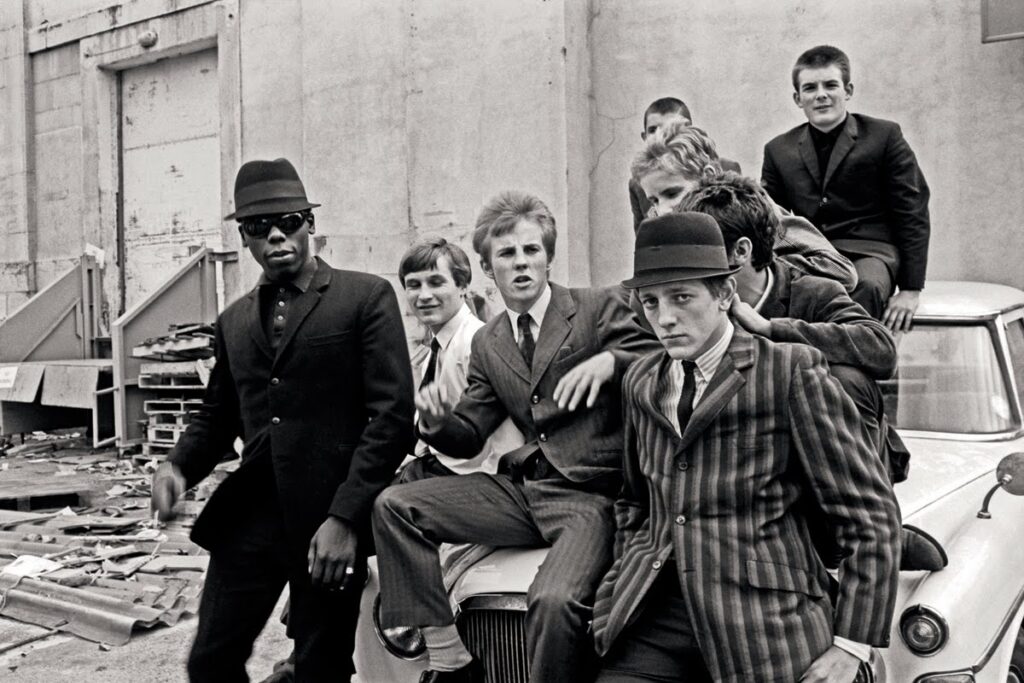
What of the apparent dichotomy between the mod and the rocker? Well, I’m not convinced that it was a very important disagreement for either group, as they didn’t really operate on the same cultural terrain. Sure, a certain post-war deterritorialisation was responsible for the germination of both subcultures. Working-class kids were not only brought into the proximity of consumer goods and high society, but had also finally acquired a limited amount of disposable time and income. However, there are limited similarities beyond these origins. One was a romantic expression of rock and roll which entrenched social roles and gender norms, where the other was a novel challenge to these things.
This being said, one commonality which I’d like to touch on is that neither group were all too interested in recruiting people to fight for some kind of cause. It seems that a modern characteristic which is frequently imposed upon historical social identities of various kinds is that they were all looking to expand ground – that mods were simply analogous to university Trots handing out flyers. Of course, consciously, we may recognise that this is not the case, but the preachy missionary mentality of most current social movements is something which we must wholly understand did not apply to this kind of subculture. I’m pretty sure most rockers did not give a shit about the marketplace of ideas.
This is my point about the supposedly consistent conflict between mods and rockers, then. What were they meant to be fighting over, if not ideology?
As far as I can tell, the rockers were primarily upset with the widely-held mod conviction that abusing amphetamines is more worthwhile than abusing one’s girlfriend. Still, it seems to me that conflicts were generally little more than isolated clashes of vanity to be magnified and projected by the media. Frankly, the mod-rocker dichotomy looks like a tool to reinforce a dominant narrative about the working-class. It’s built upon the middle-class idea that we have only two options: to reject polite society in the most caricature manner possible, or to attempt to assimilate into it. Yet, the mods were not assimilating into society! How often do well-off people actually wear ties and suits? The stylish and overly formal appearance was an utter subversion; that we will perform more effectively than you cunts ever did. That we will build up an entirely alternate and self-sufficient social structure, a la organised crime, and will all live like kings.
Ultimately, mods realised the most essential element of punk rock more explicitly than rockers ever could, prior to the incorporation of garage rock: that if you want a better life, you have to do it yourself! It’s no wonder, then, that punk was a key ingredient in binding the 2-tone subgenre together. Whilst the lyrics zoned in on classic mod and rude boy themes, the music was much faster and more aggressive than it had ever been. Unfortunately, this individualistic impulse was to be the sword which the mods fell on. Ska was gentrified to all hell by the time of its ‘third wave’ – I can’t deny that. However, I think it’s worth noting that punk rock itself was soon to follow. The LA band Operation Ivy, which in my opinion represents the last truly great expression of the synergy between punk and ska, broke up at 924 Gilman Street in 1989, just as Green Day was launching their career from the same location.
What was the impetus for punk rock? Well, it was dissatisfaction with the state of rock, of course! Rock – the music of the rocker. Punk was a new form of rock, freed from the social constraints which had built up around it. Yet, it was so much more than that!
What I’ve walked you through here is essentially the origin story of what is today known as ‘ska-punk’. Admittedly, for all my proselytising, this particular genre of music did not go very far. But just look – right here! That affix: -punk. What is that? When we describe something as ‘ska-punk’, or ‘folk-punk’, or ‘cyber-punk’, what does that mean? Are we suggesting that it rocks? Noting that it relates to rock music, perhaps? No! Punk has transcended rock a million times over! -punk denotes a way of thinking, and indeed a way of being, rather than any particular musical style, and clearly it’s a way which will carry on for infinitely longer than anyone who could hope to define or categorise it! Punk rock may have died, but punk never will.
Leave a Reply