Just sketching something out
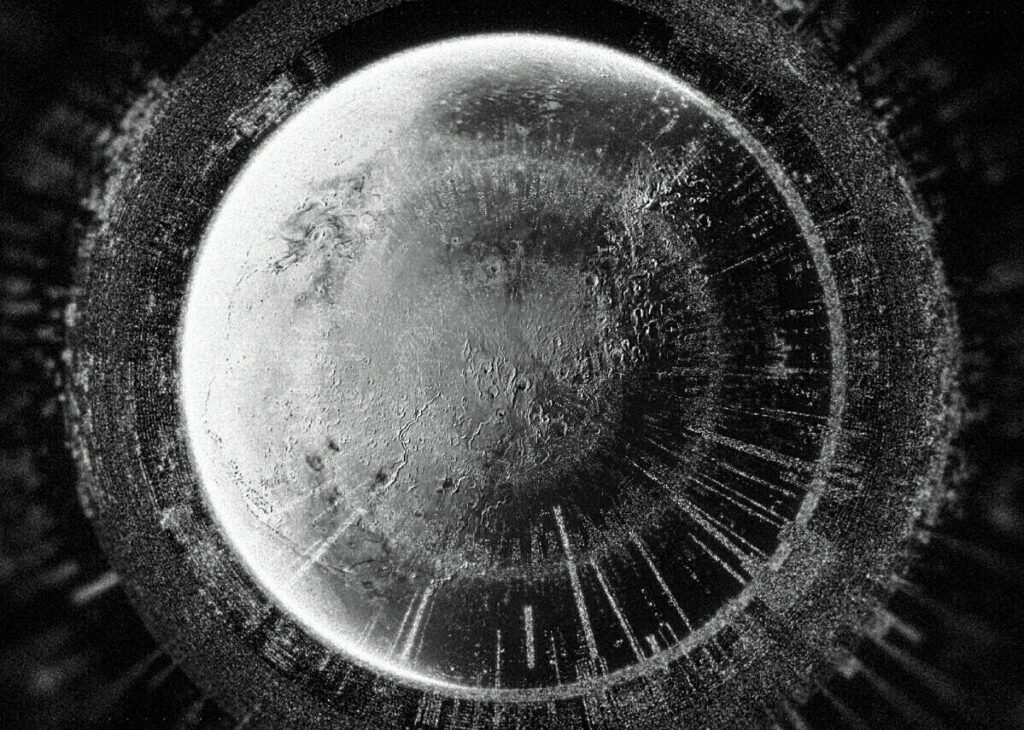
What is nature? What is a resource? What is a natural resource? I contend that the advent of industrial capitalism has abstracted these fundamental questions to the extent that we have been largely unwilling to disentwine our epistemological netting and substantively investigate.
Within European colonial modernity, our concern with the state of the natural environment is immutably extraneous to tangible impacts on capitalist society. The implied teleology of the western conception of ‘nature’ segregates it from society, especially if we conceive of modern socio-cultural life as being rooted in the scientific or rational. Nature is pure – and ever since Azazel flew in to teach the ancients how to smelt, ever since Promethius sent fire down to Greece, humanity has been impure.
Just as minimisation of informational transmission errors can be achieved through increasing message redundancy, expanding the variety and redundancy of critical resources ensures systemic stability. In the context of economic productivism, this manifests as spiralling growth and expansion fuelled by compounding energy, agricultural and technological output. The path-dependent carbon lock-in of oil and gas products throughout the past century ensures that fossil fuel consumption has continued and will continue to rise even coupled with the rapid, widespread dissemination and adoption of efficient ‘renewable’ technologies. If we intend for anything to survive the Anthropocene ecological collapse, this circumstance is intolerable.
Surely, we require some kind of fundamental reconciliation between human society and the natural world. Yet, any progressive or reactionary proposition for a return to the natural will almost invariably presuppose the utilisation of various technologies, and in such contexts the coherence of ‘nature’ as a category rapidly deteriorates. Nature itself becomes unnatural through interfacing with the technological; through interacting with the impure. As such, I am problematising the use of the term ‘nature’ itself.
To have a finger illustrate that a finger is not a finger, is not so good as to show that it is not so using something that is not a finger; and so, to have a horse illustrate that a horse is not so, is not really as good as to use something other than a horse to show this. All of Heaven and Earth function this way – all as one as a finger or a horse.
Zhuangzi1
We cannot say what nature is or is not – and this presents us with an issue. We learn often from social democrats that ‘wealth is created by labour’ or something like that. However, as Marx notes at the very opening of Critique of the Gotha Programme, labour cannot be the source of all wealth, as nature is ‘just as much the source of use values’ as labour. Indeed, ‘labour’ is merely the quotient of energy channelled into production. The energy of life on earth ultimately derives from the sun. Is the sun natural? Is excess natural?
If we try and dig down into pre-capitalist production, tools are ultimately what allow us to channel energy into productive activity. The exteriorisation of organs, the physicalisation of memory, the ‘liberation of the hands’ – this phenomenon is what distinguishes man from wild. We plunder resources with tools using labour. But this has not always been the case. It’s only retrospectively that we’ve decided to sever the activity of this species off from that of every other species on the planet. The question of ‘natural resources’ becomes quite puzzling in this context. How much can we refine something before it ceases to be natural?
The potter said, ‘I have skill with clay; to mould it into rounds like a compass or angles like a ruler.’ The carpenter said, ‘I have skill with wood: to bend it with the template or to have it straight as string.’ However, is it inherently the nature of clay and wood to conform to compasses, rulers, templates or string?
Zhuangzi2
Every reproduction and repetition of human technical activity consumes an ever-greater share of the virgin environment. Is this the case for bees? No. Yet, if we frame every iteration of technics as part of this cosmic struggle between man and nature, capital and labour, lack and excess, we collapse every determination into a temporally-conditioned singularity. The immense extractive apparatuses of technocapital merely trend towards a foregone conclusion.
We see within the production process a countervailing process of overdetermination; the transfiguring of recording through consumption, the folding back of consumption into desiring-production, the collapse of production into extraction. Each phase of the production process is determined and transmogrified by an antiproductive transposition with the previous phase. Through the static vectors of an image – of a moment – projections, inscriptions, reflections onto the recording surface allow capital to appropriate all surplus production. Every repetition is a rearticulation of the one, and retrospectively they were simultaneous.
But every new invention, every advance made by industry, detaches another piece from this domain, so that the ground which produces examples illustrating such Feuerbachian propositions is steadily shrinking. The ‘essence’ of the fish is its ‘being’ – water; to go no further than this one proposition: the ‘essence’ of the freshwater fish is the water of a river. But the latter ceases to be the ‘essence’ of the fish and is no longer a suitable medium of existence as soon as the river is made to serve industry, as soon as it is polluted by dyes and other waste products and navigated by steamboats, or as soon as its water is diverted into canals where simple drainage can deprive the fish of its medium of existence.
Marx & Engels3
Industrialisation drenches every crevice of every ecological biome with the patterns and demarcations of human technics. As such, I contend that the intertwined processes of financialisation, digitisation, securitisation and so on which we see under international capitalism become technological, rather than merely technical. We can explore this distinction in the future.
Yuk Hui turns to Chinese cosmology for an alternative to the Promethean explanation of technological progress, seeking to thread a culturally-specific cosmology together with the use of tools amongst humans. In the episteme of the Han Dynasty, ‘Qi’ might be understood as ‘technical object’, and ‘Dao’ as a method.4 Hence, if ‘Qidao’ – the unification of Dao and Qi – comes to represent the attainment of a ‘highest standard’ of morality, one can trace a moral order based on a way of using technical objects. Within the resonance between Heaven and Earth, technics are in accordance with the virgin environment. The Dao is not in contention with nature.
Of course, the production of subsistence and material life begins with tools. There’s a materialist basis to tracing the technical through the cosmological – although it necessarily introduces a metaphysical dimension. I should note also that Hui specifically defines cosmotechnics as the unification of a ‘cosmic order’ and a ‘moral order’ through technical activity,5 underlining the extent to which this particular concept is intertwined with Confucian morality. We must question whether the epistemological conditions of Imperial China are actually a suitable environment from which to divine the tools for a comprehensive ontological rework.
At this stage, I am not advocating for the universalisation of a reconstructed Chinese cosmotechnics. Nor am I currently seeking the consolidation of supranational trade blocs of semi-continental scale which codify their official ‘philosophies of technology’ and seek to reformulate productive output in accordance with some spiel of idealist platitudes. However, if you are a materialist, there comes a time to ask about the nature of the material.
Endnotes
- ‘The Smoothing of Controversies’ in The Book of Zhuangzi ↩︎
- ‘Horses’ Hooves’ in The Book of Zhuangzi ↩︎
- ‘Feuerbach II [9. Idealist Conceptions of History and Feuerbach’s Quasi-Communism]’ in The German Ideology ↩︎
- ‘Dao and Cosmos: The Principle of the Moral’ in The Question Concerning Technology in China ↩︎
- ‘Cosmos, Cosmology, and Cosmotechnics’ in The Question Concerning Technology in China ↩︎
Leave a Reply